
Computer Lab Furniture
Two-seat computer tables, student chairs and teacher furniture for school labs - the full specification, the dimensions that matter, and indicative prices.
Specify the Table by Its Width
The most expensive mistake in computer lab furniture is not buying a cheap table. It is buying a table 200 millimetres too wide.
In a 25 by 30 foot lab - about 70 square metres, the size of a large classroom - two-seat tables of 1000 mm width allow 30 machines: twenty positions around the perimeter and ten in a back-to-back island, with a usable aisle of around 1.1 metres throughout. The same room specified with 1200 mm tables fits about 23. Seven workstations, close to a quarter of the lab's capacity, disappear in exchange for extra table width that a school desktop and a 21.5 inch monitor simply do not need.
At an indicative Rs. 64,000 per workstation of IT hardware, those seven lost positions are more than Rs. 4.5 lakh of capacity - and the school usually discovers it only when the furniture has already been made to order. Draw the room against the actual table dimension before the purchase order goes out. The layout arithmetic is set out in full on our computer lab design guide.
The 600 mm depth matters for a different reason. It is the practical minimum that leaves a 21.5 inch monitor at a sensible viewing distance once the keyboard tray is pulled out. Go shallower to save floor area and you will be fielding eye-strain complaints within a term.
Full Table & Chair Specification
Write these lines into the purchase order rather than a brand name. They are what separates furniture that lasts ten years from furniture that lasts three.
| Element | Specification |
|---|---|
| Top | 18 mm pre-laminated particle board (IS 12823 class), edge-banded on all exposed edges. Edge banding is where cheap tables fail first. |
| Frame | MS tube, typically around 25 x 25 x 1.2 mm, powder coated to about 50 microns after degreasing and phosphating. Ask for the micron figure. |
| Size | 1000 x 600 x 750 mm for a two-seat student table. 1200 x 600 x 750 mm for the teacher table with a lockable pedestal. |
| Keyboard tray | Full-width tray on smooth runners, set below the top so the keyboard sits lower than the monitor. |
| CPU support | Trolley or cage keeping the machine off the floor, clear of mop water and with airflow at the intake. |
| Grommets | Two cable grommets in the top per two-seat position, for monitor and power cables. |
| Modesty panel | Full or partial panel between the legs on the student-facing side. |
| Cable management | Tray or spine under the top, continuous along an island run, so cables are contained rather than looped across the floor. |
| Student chair | Polypropylene or HDPE shell on an MS frame, armless, stackable, non-revolving (IS 17632 class). Not a gas-lift chair. |
| Teacher chair | Medium-back revolving chair with gas lift and arms (IS 17631 class). |
Indicative Furniture Prices
| Item | Size | Indicative price | Quantity for a 60-seat lab |
|---|---|---|---|
| Two-seat computer table | 1000 x 600 x 750 mm | Rs. 7,500 - 9,000 | 30 |
| Student chair, stackable, non-revolving | Standard | Rs. 1,100 - 1,400 | 60 |
| Teacher table with lockable pedestal | 1200 x 600 x 750 mm | Rs. 6,500 - 8,000 | 2 |
| Teacher chair, medium-back revolving | Standard | Rs. 3,500 - 4,500 | 2 |
| Steel almirah, 4 shelves, lock | 1980 x 915 x 485 mm | Rs. 10,000 - 12,500 | 1 |
| Printer / MFP stand with paper shelf | 900 x 600 mm | Rs. 4,000 - 5,500 | 1 |
| Magnetic whiteboard + notice board | 1800 x 1200 / 1200 x 900 mm | Rs. 11,000 - 14,000 | 1 set |
| Sunscreen roller blinds, 3-5% openness | Per sq ft, installed | Rs. 130 - 180 | Window area |
| Asset tags, lab name board, safety signage | Lot | Rs. 10,000 - 15,000 | 1 lot |
| CO2 extinguisher 4.5 kg with stand | IS 2190 class | Rs. 4,000 - 5,500 | 2, one per door |
Indicative ex-GST ranges for budgeting, derived from a 2026 Bengaluru estimate for a 60-seat school lab. Actual rates depend on quantity, board and frame specification and current material prices, and are confirmed on quotation.
Taken together, the furniture package for a 60-seat lab lands at roughly Rs. 4 to 4.5 lakh ex-GST - about 12 percent of the turnkey cost of the lab. The full package-wise split is on the computer lab setup cost page.
Why Not Revolving Chairs for Students?
It is the most common request and it is almost always the wrong answer for a school computer lab. A revolving task chair costs roughly three times a stackable student chair, and in a school lab it fails in three predictable ways.
The gas lift goes first. It is the component under the most abuse from students raising and dropping the seat, and it cannot be economically repaired - the chair is effectively scrap when it fails, usually well inside three years.
Second, a chair that swivels and rolls is a toy. In a room of sixty students that is a supervision problem the teacher will mention to you within the first month.
Third, and most practically, revolving chairs do not stack. The moment you want to use the lab for an examination, a training session or a parent meeting, sixty chairs have to go somewhere, and there is nowhere for them to go. A stackable chair lets the room be cleared in ten minutes.
Specify an armless, stackable, non-revolving chair with a moulded polypropylene or HDPE shell on an MS frame - the IS 17632 class of non-revolving chair. Put the revolving chair, to IS 17631, at the teacher's table where it belongs and where it will be treated properly.
Computer Lab Setups We Deliver
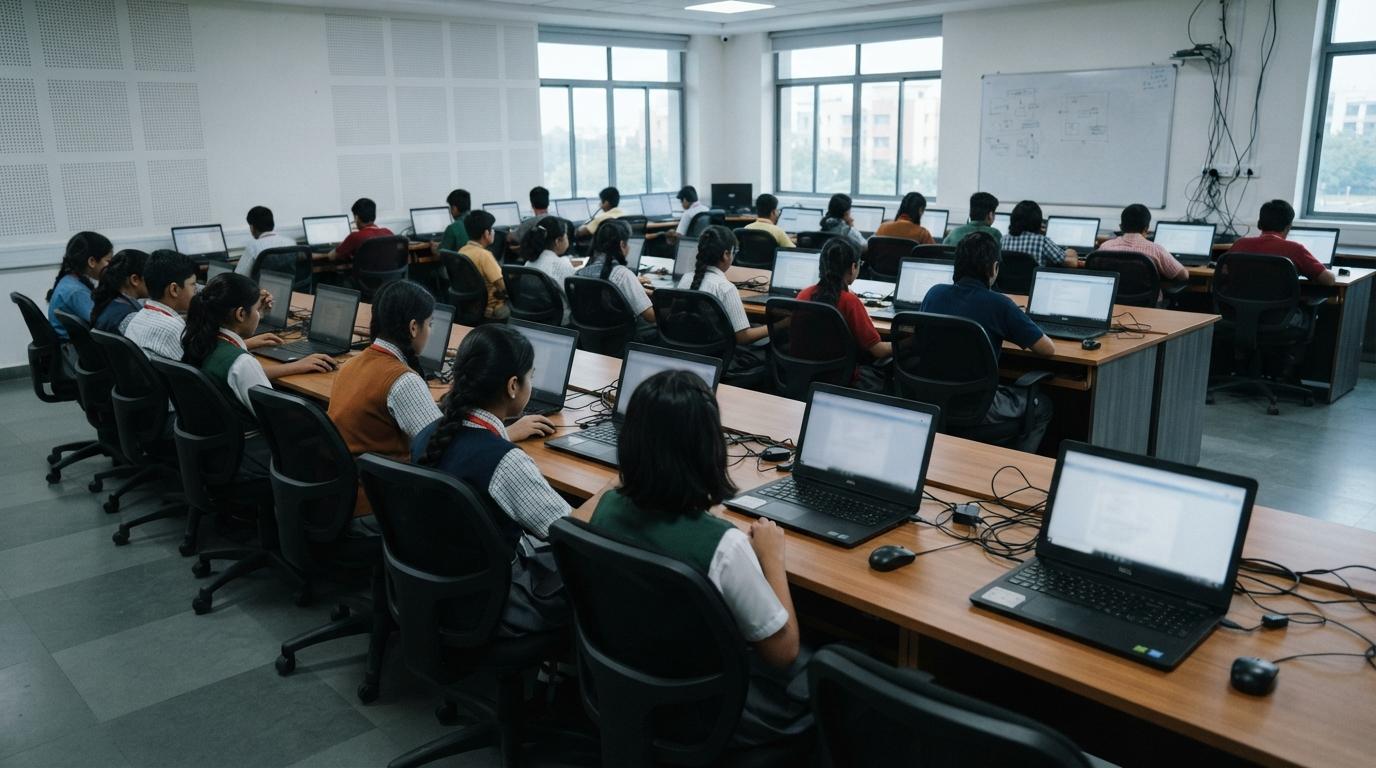
Turnkey Lab Fit-Out
Tables, chairs, teacher furniture, storage and signage supplied and assembled to the approved layout, with cable management designed in rather than added afterwards.
Computer Lab Setup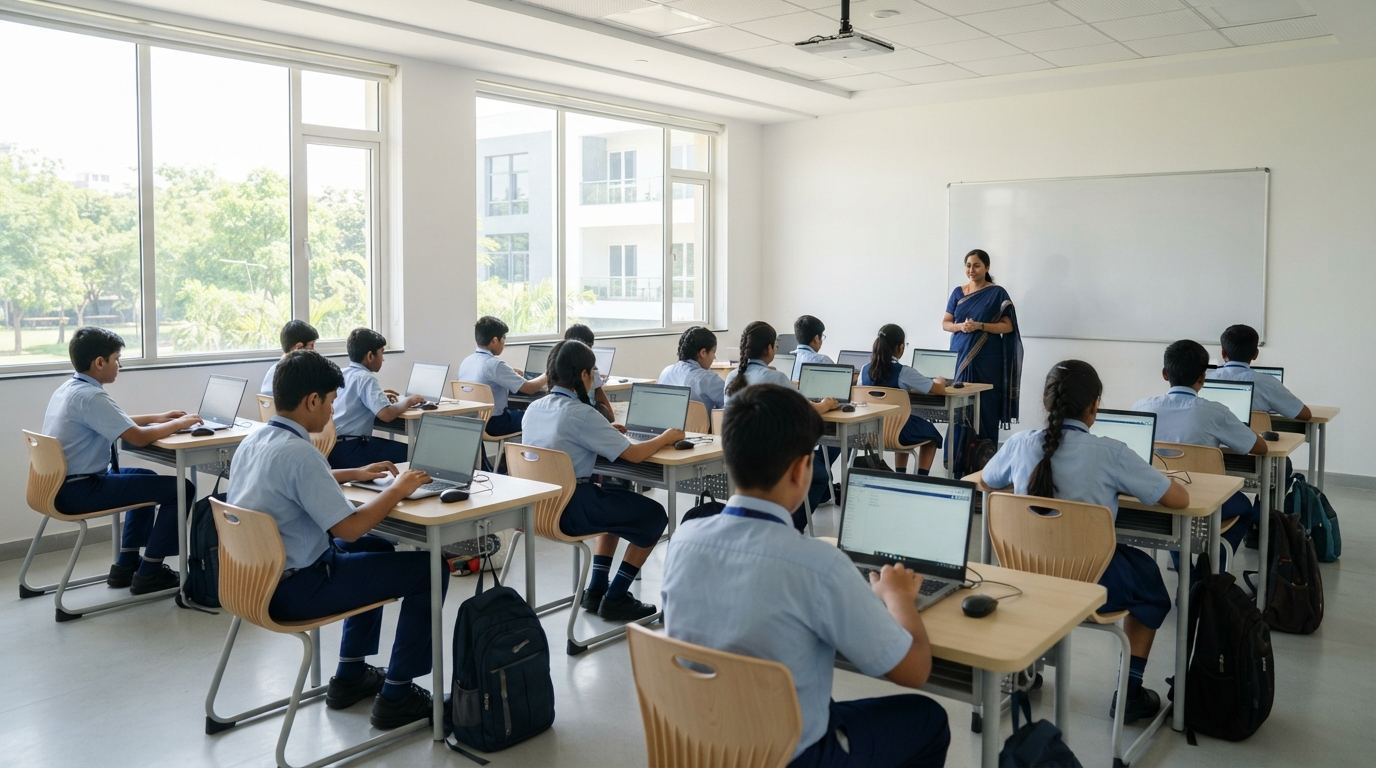
Furniture Only
Where the room and the machines are already in place, we supply and install the furniture package on its own, drawn to your room and delivered in one lot.
Lab FurnitureFrequently Asked Questions
What size should a computer lab table be?
A two-seat table of 1000 x 600 x 750 mm is the right default for a school lab. The width matters more than anything else in the specification: in a 25 by 30 foot room, 1000 mm tables allow 30 machines, while 1200 mm tables allow only about 23. The 600 mm depth is the practical minimum that puts a 21.5 inch monitor at a sensible viewing distance once the keyboard tray is in use; shallower tables cause eye strain complaints within a term. Seven hundred and fifty millimetres is the standard working height for a table used with a separate chair.
What does computer lab furniture cost?
Indicative ex-GST ranges. A two-seat computer table of 1000 x 600 x 750 mm in 18 mm pre-laminated board on a powder-coated MS frame, with keyboard tray, CPU trolley, grommets, modesty panel and a cable tray, runs roughly Rs. 7,500 to Rs. 9,000. A stackable non-revolving student chair runs roughly Rs. 1,100 to Rs. 1,400. A teacher table of 1200 x 600 x 750 mm with a lockable two-drawer pedestal runs roughly Rs. 6,500 to Rs. 8,000, and a medium-back revolving teacher chair roughly Rs. 3,500 to Rs. 4,500. On a 60-seat lab, furniture works out to about 12 percent of the total turnkey cost.
Should students have revolving chairs in a computer lab?
No. Specify armless, stackable, non-revolving chairs with a polypropylene or HDPE shell on an MS frame. Revolving chairs in a school lab fail in three ways: the gas lift is the first thing to go and it cannot be economically repaired, students adjust and spin them instead of working, and they cannot be stacked, so the room cannot be cleared for any other use. Non-revolving stackable chairs cost a third as much, last far longer in daily student use, and let the lab double as an exam hall when needed. Keep the revolving chair for the teacher.
What board and frame should the tables use?
Eighteen millimetre pre-laminated particle board of the appropriate grade, edge-banded on all exposed edges - the edge banding is where cheap furniture fails first, because unsealed particle board swells the moment it meets a mop. The frame should be MS section of adequate gauge, typically around 25 x 25 x 1.2 mm tube, powder coated to about 50 microns after proper pre-treatment. Ask for the coating thickness in microns and the pre-treatment process, not just the word 'powder coated' - paint over untreated steel will start rusting at the welds within two monsoons.
What should the table include besides the top?
Five things, and each of them is a line schools forget and then miss. A keyboard tray on smooth runners, so the keyboard is at a lower level than the monitor. A CPU trolley or cage, so the machine is off the floor and away from mop water. Two cable grommets in the top for monitor and power cables. A modesty panel between the legs, which matters in a school. And a cable tray or spine under the top so thirty-one machines' worth of cables are contained rather than looped across the floor. A table without cable management turns into a hazard within a month.
Is computer lab furniture covered by a BIS standard?
Furniture in India is progressively coming under BIS quality control orders, and the relevant Indian Standards for institutional seating include IS 17631 for office revolving chairs and IS 17632 for non-revolving chairs. Pre-laminated particle board is covered by IS 12823. Rather than relying on a general claim of compliance, ask your supplier which certification applies to the specific product at the time of your order, and write the component specification - board thickness and grade, frame section and gauge, coating microns, edge banding - into the purchase order as well.
How do we plan cable management?
Decide it with the layout, not after. In a perimeter arrangement, power and data points sit on the wall behind the tables and each table needs only a short drop, which is the simplest and cheapest arrangement. In a back-to-back island, the two rows share a central spine carrying power and data along the length, with grommets bringing cables up through the top. In either case the table must have a tray or spine, the CPU must be off the floor, and the cables should be labelled at both ends. Floor-level cable runs across an aisle are never acceptable in a room with sixty students in it.
What else does the lab need besides tables and chairs?
A teacher table with a lockable pedestal and a revolving chair. A steel almirah for spares, media, licence documents and the as-built file. A printer or MFP stand with a paper shelf. A magnetic whiteboard and a notice board. Sunscreen roller blinds of 3 to 5 percent openness on the windows to kill screen glare without darkening the room. Asset tags on every machine and item of furniture, a lab name board and lab rules signage. And two carbon dioxide extinguishers on stands, one at each door - not water or foam, in a room full of energised electronics.
Need Computer Lab Furniture?
Tell us the room dimensions and the number of machines. We will draw the layout, confirm the table width that actually fits, and quote the package.
Related Pages
Computer Lab Design
Room sizing, layout options, lighting, power, cooling and cabling with the arithmetic shown.
Design GuideComputer Lab Setup Cost
Package-wise breakdown from a real 60-seat lab and indicative cost by lab size.
Cost GuideScience Lab Furniture
Work benches, sinks, fume hoods and storage for physics, chemistry and biology labs.
Lab FurnitureClassroom Furniture
Student desks and benches, teacher furniture and library furniture supplied in bulk.
School Furniture