
Atal Tinkering Lab Equipment List (ATL Packages P1–P4)
What actually goes into an Atal Tinkering Lab, package by package, with the suggested quantities AIM publishes for a batch of 60 students — plus what the Rs. 20 lakh grant covers, what it does not, and indicative costs. Written for schools with a sanctioned ATL grant who now have to raise a specification and buy.
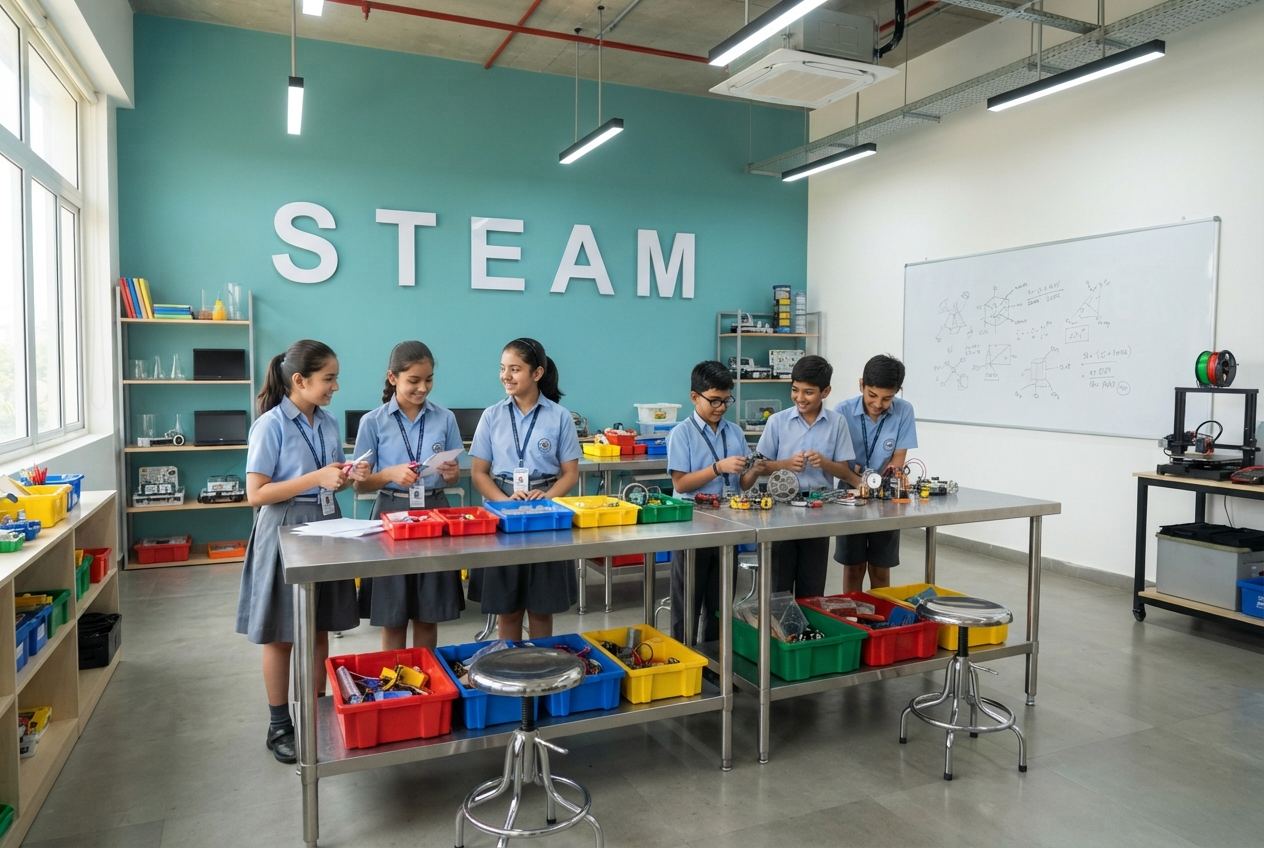
Where the Official ATL Equipment List Lives
The authoritative list is published by the Atal Innovation Mission, NITI Aayog, at aim.gov.in/guidelines-for-school.php, together with the ATL procurement guideline. AIM publishes two versions — an ATL Equipment List for a batch of 60 students and one for a batch of 90 students — each giving, for every line item, a written specification, a suggested quantity and a type: Equipment or Consumable.
Two things about that list are easy to miss. First, AIM states that the list is not exhaustive, but that it is mandatory for schools to purchase all the equipment mentioned in it, as per their requirement. Second, the list is revised: the 2026 AIM 2.0 Frontier Region Program manual carries an enhanced version of the same four packages, renamed C1 to C4, with tighter, brand-neutral specifications. Always raise your specification against the current PDF on the AIM portal on the day you float the requirement — not against any vendor's copy of it, including the summary on this page.
No vendor is approved by NITI Aayog. The ATL equipment list says so in terms: “NITI Aayog is not endorsing any equipment supplier / vendor, nor has empanelled anyone”, and no vendor is allowed to use ATL or NITI branding, logos or names on their website or at their events. AIM circulates an indicative vendor list to ATL schools, but the final decision on selecting a vendor rests entirely with the school, and schools may buy outside that list. CBM IMPEX is an ordinary GST-registered supplier quoting against the published list — nothing more. Treat “AIM-approved ATL vendor” as a red flag on anyone's website.
The Four ATL Packages
AIM classifies everything considered necessary for a tinkering lab into four packages
| Package | Covers | Character of the spend |
|---|---|---|
| P1 | Electronics Development, Robotics, Internet of Things and Sensors | Largest package; mostly consumable-classified boards, modules and components |
| P2 | Rapid Prototyping Tools | The 3D printer and its UPS, filament and craft prototyping material |
| P3 | Mechanical, Electrical and Measurement tools | Hand tools, power tools, soldering, oscilloscope — mostly durable equipment |
| P4 | Power Supply, Accessories and Safety equipment | Fasteners, cabling, extensions and the mandatory safety kit |
AIM's procurement guideline asks that a vendor be able to supply at least two packages, of which at least one is P1 or P2, and says it is preferable that a single vendor can supply all four. It also makes a platform point worth repeating: components across robotics, IoT and electronics platforms are usually not interchangeable, so a school should evaluate the available P1 platforms, pick one, and buy every component on that same platform. Mixing platforms across purchase orders is the most common way an ATL ends up with drawers of parts that will not work together.
What a Batch-of-60 ATL Actually Contains
Representative items and AIM's suggested quantities, package by package
Electronics Development, Robotics, IoT and Sensors
- Controller boards — Arduino Uno or equivalent ×30, Arduino Nano ×10, Arduino Mega ×10, Raspberry Pi 3 Model B+ ×5, each with enclosure and USB cable.
- Prototyping and passives — 400-pin and 800-pin solderless breadboards (×30 and ×20), FR2 general-purpose solderable boards ×30 each in two sizes, male and female berg strips ×30, resistor, capacitor and transistor kits ×20, 7805/7809/7812 regulators ×30.
- Display and interface — 16×2 I2C LCD ×20, 8×8 MAX7219 LED matrix ×10, 7-segment display modules ×20, 16-key keypads ×10, 2-axis joysticks ×10, active buzzers ×40 in two sizes.
- Connectivity — HC-05 Bluetooth ×15, SIM900 GSM ×4, NEO-6M GPS ×4, ASK RF transmitter/receiver pairs, USB cable sets ×10 each.
- Robotics — DC motors with drivers, servo motors, L293D motor driver modules ×10, robot chassis kits, wheels and hardware.
- Sensors — IR sensor arrays and line-following modules, PIR motion, ultrasonic distance, colour, sound, temperature and humidity, Hall effect, capacitive touch, pulse rate, LDR light modules ×30, laser diode emitters ×10.
- Power — 9–12V 2000–2500 mAh rechargeable batteries with chargers ×10, submersible pump modules ×4, piezoelectric plates ×30.
- Kits — DIY kits, a STEM/learning kit and a biology kit.
Rapid Prototyping Tools
- 3D printer kit ×1 — FDM, minimum 160×160×160 mm build volume (or 4 litres), 0.3–0.4 mm nozzle, heated print bed, LCD screen showing print metrics, free or open-source slicing software, PLA/ABS/Ninjaflex compatible, anti-bacterial cover and a repair kit of spare springs, screws, keys and tweezers.
- Dedicated UPS ×1 — two-hour battery backup for the printer. This is a line item in the official list, not an upsell; a power cut mid-print ruins the job.
- Filament ×5 — 1 kg spools in five colours, plus five compatible filament storage boxes.
- Arts and crafts prototyping material — cardboard and foam-core boards ×5 each, thick string spools ×5, rubber bands ×100, popsicle sticks ×100, 500 ml wood glue ×2.
Mechanical, Electrical and Measurement Tools
- Cutting and shaping — 12″ and 6″ hacksaw frames with 10 blades each, 6-piece file set and mini file set, A3 flexible cutting mat.
- Gripping and fastening — 4.5″ plier set (circlip, long nose, combination, wire stripping, bent nose, needle nose), 6-piece non-magnetic tweezer set ×2, 3″ C-clamps ×4, table-top vice, 12-piece spanner set (4–30 mm), 10-piece Allen key set, adjustable wrenches ×2.
- Driving and drilling — 500 W drill machine with masonry, metal and wood bits, a compatible drilling workstation, 13-piece HSS drill bit set, 40-piece screwdriver sets ×3, 6-piece precision screwdriver sets ×2, electric screwdriver, cordless rotary multitool up to 30,000 rpm with cutting, grinding, polishing and engraving bits.
- Hammers and blowers — 0.75 kg ball pein hammer, 0.75 kg steel-shaft claw hammer, 500 W variable-speed air blower.
- Electrical and measurement — digital oscilloscope (minimum 50 MHz, two channels, 1 GSa/s, with an inbuilt function generator), soldering kits ×4 (15–30 W iron, 280–450 °C, desoldering pump, solder wick, flux, rosin-core wire, bevel/chisel/conical tips), hot glue guns ×4, 5V and 12V 2A DC adapters ×10 each, wire strippers ×5.
- Storage — 60-drawer plastic organisers ×2 and 3 ft × 2 ft wall pegboards ×2, so tools are visible and get put back.
Power Supply, Accessories and Safety Equipment
- Consumable hardware — 11×200 mm hot-melt glue sticks ×100, M4/M5/M6 nuts, bolts and screws ×40, small, medium and large cable tie packs ×10 each, sandpaper in grits 80/100/120/200/300.
- Power distribution — 5-socket power strips with a 5 A safety fuse and 5 m lead ×5, bulb holders ×10, 20 m twisted red/black wire, USB-to-DC jack cables ×10.
- Safety kit — polycarbonate clear safety goggles ×30, latex-coated gloves ×10 pairs, filtering safety masks ×20, portable first-aid kits ×2, 2 kg dry-powder fire extinguishers ×2.
The suggested quantities above are AIM's, for a batch of 60 students. The batch-of-90 list scales several of them up. A school does not have to buy exactly these counts — the list says “as per their requirement” — but any material shortfall against the published list is the first thing a utilisation review will pick up.
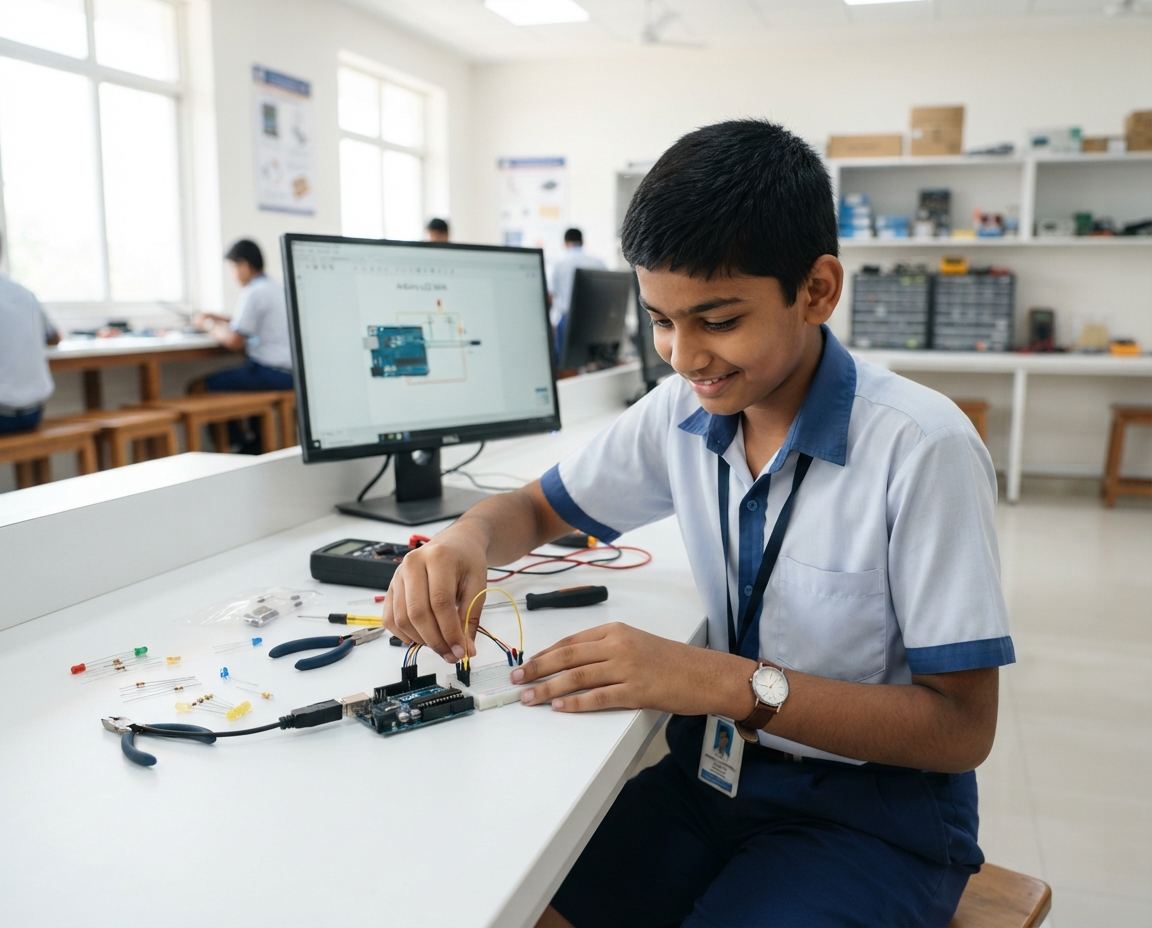

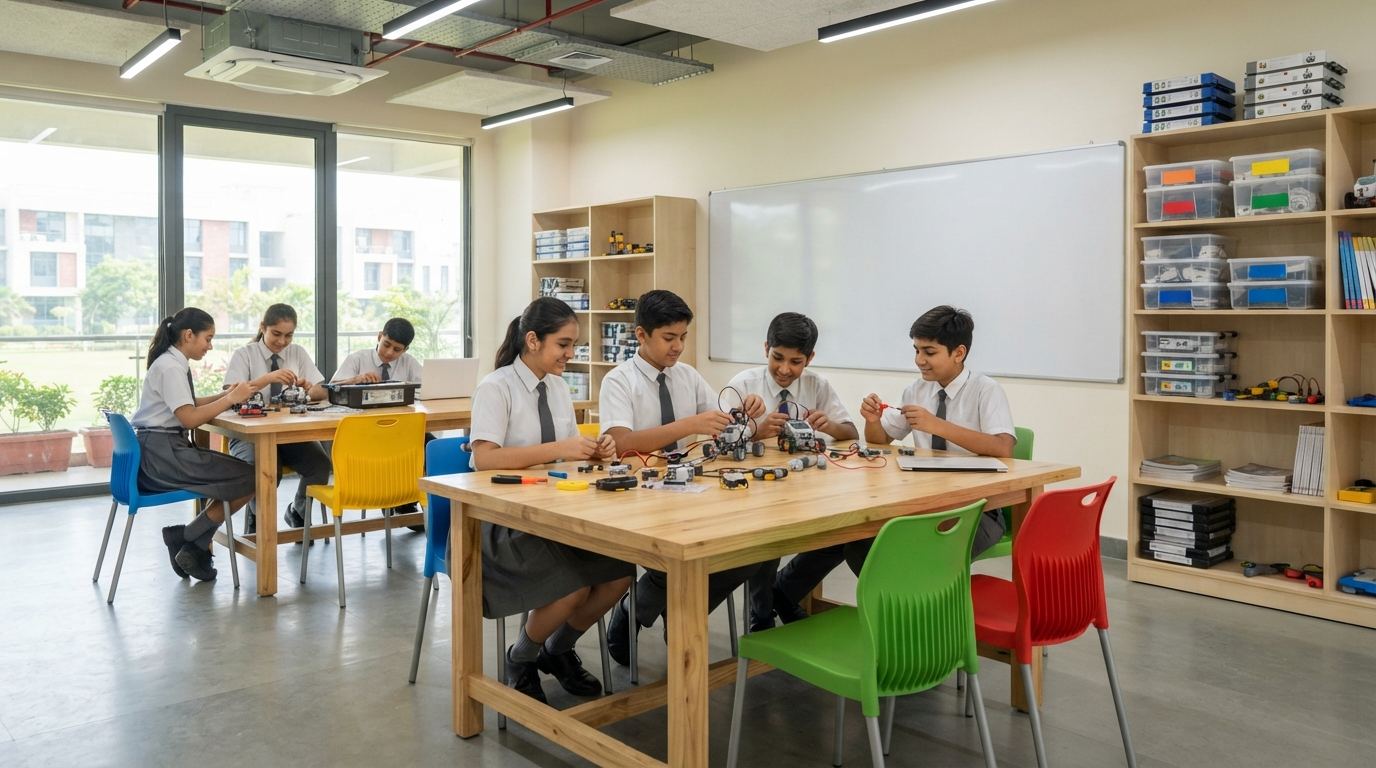
What the Rs. 20 Lakh ATL Grant Covers — and What It Does Not
AIM sanctions a grant-in-aid of Rs. 20,00,000 per school for a maximum period of five years, in two halves. The establishment half is broken down in AIM's own manual as follows:
| Head | Ceiling | What it buys |
|---|---|---|
| Standard equipment | Up to Rs. 7,00,000 | Procurement against the ATL equipment list — packages P1, P2, P3 and P4. This is a hard cap: the total quotation for all four packages must not exceed it. |
| Refurbishment, furnishment and branding | Up to Rs. 1,30,000 | Electrical fittings, painting and whitewash; furniture — tables, chairs, storage boxes; printing of the lab banner, board and signage. |
| ICT infrastructure | Up to Rs. 1,70,000 | Two laptops, one desktop with upgraded specifications, and one projector. |
| Establishment total (year 1) | Up to Rs. 10,00,000 | One-time establishment charge, released in the first year. |
| Operational grant | Up to Rs. 10,00,000 | Spread over up to five years: operation of the lab, maintenance of equipment, purchase of consumables, popular science lecture series, innovation events and other scientific activities, competitions, and honorariums to the faculty and mentors involved. |
Read that table against your own building and the gaps become obvious. The grant does not fund the room. Civil work beyond painting and electrical fittings, flooring, windows, air conditioning, a dust-free enclosure for the printer, networking beyond the four ICT devices, and a proper laboratory-grade workbench run rather than Rs. 1,30,000 of tables and chairs — all of that is the school's own spend if it wants it. Nor does the grant fund salaries: the operational head pays honorariums to faculty and mentors, not a full-time instructor.
Schools that plan for those two gaps up front get a working lab. Schools that do not tend to end up with Rs. 7 lakh of equipment on classroom desks in a room nobody has timetabled.
Indicative ATL Cost Bands
| Package | Indicative range | What drives the number |
|---|---|---|
| P1 — Electronics, robotics, IoT, sensors | Rs. 2,40,000 – 3,20,000 | Which robotics/IoT platform you standardise on, and whether boards are branded or equivalent |
| P2 — Rapid prototyping | Rs. 1,00,000 – 1,50,000 | 3D printer build volume and build quality; the mandatory two-hour UPS |
| P3 — Mechanical, electrical, measurement | Rs. 1,10,000 – 1,70,000 | Dominated by the oscilloscope spec and the quality of the power tools |
| P4 — Power supply, accessories, safety | Rs. 40,000 – 60,000 | Largely fixed; the safety kit is non-negotiable |
| P1–P4 total | Rs. 4,90,000 – 7,00,000 | AIM caps the combined quotation at Rs. 7,00,000 |
| Refurbishment, furniture, signage | Up to Rs. 1,30,000 | AIM ceiling; what it actually costs depends on the room you start with |
| ICT — 2 laptops, 1 desktop, 1 projector | Up to Rs. 1,70,000 | AIM ceiling |
These bands are indicative only. They are our reading of what the published specifications cost to meet at current market rates, not a quotation and not an AIM figure — the ceilings in the last two rows are AIM's, the package ranges are ours. Actual prices move with the platform you choose, brand versus equivalent parts, and the GeM rates on the day you buy.
What AIM Requires of Your Supplier
Straight from the ATL procurement guideline — use it as your evaluation checklist
- GeM only. All procurement shall be made through the GeM portal, following GeM procurement guidelines, at the lowest quote.
- Installation free of charge, at the school.
- Training free of charge for the Principal, ATL in-charge and faculty, on handling and usage, at the school site, after delivery.
- Two years comprehensive warranty at no additional charge — the 3D printer included — with a replacement unit supplied while an item is being repaired.
- Three years comprehensive AMC at no additional charge, with the terms stated clearly.
- Delivery, installation and training within one month of the order, with the timeline stated in the quotation.
- Consumables supply chain maintained for five years.
- Itemised and package-wise pricing, with brand name and detailed specification for every item.
- An e-waste disposal mechanism.
- Signed, verifiable documentation from an authorised signatory at the time of purchase.
If a quotation does not carry all of that in writing, it is not a compliant ATL quotation, whatever the headline price says. AIM also asks schools to verify a supplier's company details on the MCA portal before ordering, and reserves the right to audit the school and its ATL expenses at any point. Queries go to the AIM helpdesk at atlhelp-niti@nic.in — not to the vendor.
Room, Eligibility and Timeline
| Requirement | What AIM specifies |
|---|---|
| Built-up space | Minimum 1,500 sq ft under the mainline ATL guidelines; 1,000 sq ft in hilly, Himalayan and island states. The 2026 AIM 2.0 Frontier Region Program manual sets a minimum of 750 sq ft. |
| School type | Schools running at least Grades VI–X, managed by State or Central Government, a local body, a private trust or society, or a tribal/social welfare department. |
| Enrolment | Minimum 400 students in Grades VI–X (250 in hilly states) under the mainline screening criteria. |
| Commitment | Selected schools sign a Memorandum of Agreement with AIM; a Bond is also executed, except by Government and local-body schools. |
| Time to operational | Three months from receiving the grant-in-aid and guidelines, to set up the lab, inaugurate it and make it functional. |
Three months sounds generous until you work backwards. Raising the specification, running GeM price discovery and getting sanction internally takes most schools four to six weeks; AIM obliges the vendor to deliver, install and train within one month of the order. That leaves the room preparation — wiring, points, painting, benches — as the only slack in the schedule, which is why it should start the week the grant lands, in parallel with procurement rather than after it.
How CBM IMPEX Quotes an ATL
We are a GST-registered B2B school equipment supplier in Basavanagudi, Bengaluru, supplying schools across Karnataka. For an ATL we quote the way AIM asks a vendor to quote, and nothing beyond it:
- A package-wise and itemised quotation against the current AIM equipment list, with brand and specification per line, so you can lay it side by side with the published PDF.
- A single P1 platform recommended and priced through, rather than a mix of incompatible boards and modules.
- Installation, on-site training, two-year warranty and three-year AMC included in the price, because AIM requires them to be.
- A room layout and electrical plan for your space — bench positions, power points, printer corner, tool wall and storage — so the Rs. 1,30,000 refurbishment head is spent on the right things.
- The documentation set a utilisation review expects: signed invoices, delivery notes, installation and training records, warranty and AMC terms.
If your school is not in an ATL round, the same equipment can be bought outright as a school robotics lab or a STEM lab, and the teaching side can be handled through a managed innovation lab programme. Colleges setting up an equivalent facility should start at robotics lab for colleges. Benches, stools and storage for the room are on our lab furniture page.
Frequently Asked Questions
What is in the Atal Tinkering Lab equipment list?
AIM classifies all ATL equipment into four packages: P1 Electronics Development, Robotics, Internet of Things and Sensors; P2 Rapid Prototyping Tools; P3 Mechanical, Electrical and Measurement tools; and P4 Power Supply, Accessories and Safety equipment. Each line item in the official list carries a specification, a suggested quantity and a type (Equipment or Consumable). AIM publishes separate lists for a batch of 60 students and a batch of 90 students at aim.gov.in.
Where is the official ATL equipment list published?
On the AIM portal at aim.gov.in/guidelines-for-school.php, alongside the ATL procurement guideline. The batch-of-60 and batch-of-90 equipment lists are published as PDFs under aim.gov.in/pdf/. Always quote against the current version on that page, because the list is revised from time to time — the 2026 AIM 2.0 manual, for example, renames the same four packages C1 to C4 and tightens several specifications.
How much of the Rs. 20 lakh ATL grant can be spent on equipment?
The grant is Rs. 20 lakh over five years: Rs. 10 lakh as a one-time establishment charge in year one, and Rs. 10 lakh for operations over up to five years. Within the establishment tranche, AIM's manual allocates up to Rs. 7,00,000 for the ATL equipment list itself (packages P1 to P4 combined, which is a hard cap on the total quotation), up to Rs. 1,30,000 for refurbishment, furniture and signage, and up to Rs. 1,70,000 for ICT infrastructure — two laptops, one desktop and one projector.
What does the Rs. 10 lakh operational grant cover?
Running the lab over up to five years: maintenance of equipment, consumables, popular science lecture series, innovation events, competitions and honorariums to the faculty and mentors involved. It is not meant for the initial equipment purchase, which comes out of the establishment tranche.
How must an ATL school buy its equipment?
AIM's procurement guideline states that all procurement shall be made through the GeM portal only, and that schools should follow the GeM procurement guidelines and procure at the lowest quote. Schools are expected to carry out their own price discovery and due diligence, and AIM reserves the right to audit the school and the associated expenses at any point.
Is any vendor approved or empanelled by NITI Aayog for ATL supply?
No. The ATL equipment list states plainly that NITI Aayog is not endorsing any equipment supplier or vendor, nor has it empanelled anyone, and that no vendor may use ATL or NITI branding, logos or names on their website or at events. AIM circulates an indicative — not exhaustive — list of vendors to ATL schools, but the final choice of vendor rests entirely with the school. Treat any claim of being an 'AIM-approved ATL vendor' as a warning sign.
What is an ATL supplier obliged to give the school?
Under AIM's procurement guideline the vendor must install the equipment and train the Principal, ATL in-charge and faculty at the school site at no additional charge; give two years of comprehensive warranty including on the 3D printer, with a replacement unit while an item is under repair; give three years of comprehensive AMC at no additional charge; deliver, install and train within one month; maintain a consumables supply chain for five years; quote both itemised and package-wise prices with brand and full specification; and have a mechanism for e-waste disposal.
How much space does an ATL need, and how quickly must it be running?
The mainline ATL guidelines ask the school for a minimum of 1,500 sq ft of built-up space, reduced to 1,000 sq ft in hilly, Himalayan and island states; the 2026 AIM 2.0 Frontier Region Program manual sets 750 sq ft. Schools must set up the lab, inaugurate it and make it operational within three months of receiving the grant-in-aid and the guidelines.
Have an ATL Grant? Get a Package-Wise Quotation
Send us your batch size and room dimensions and we will quote P1–P4 line by line against the current AIM equipment list, with installation, training, warranty and AMC included.