
Robotics Lab for Colleges & Higher Education
Turnkey robotics and innovation labs for PU colleges, degree colleges and engineering campuses — advanced equipment, project mentoring and program instructors under one long-term partnership. Authorised Channel Partner for AMAZEHEADS — Inspiring Young Minds.
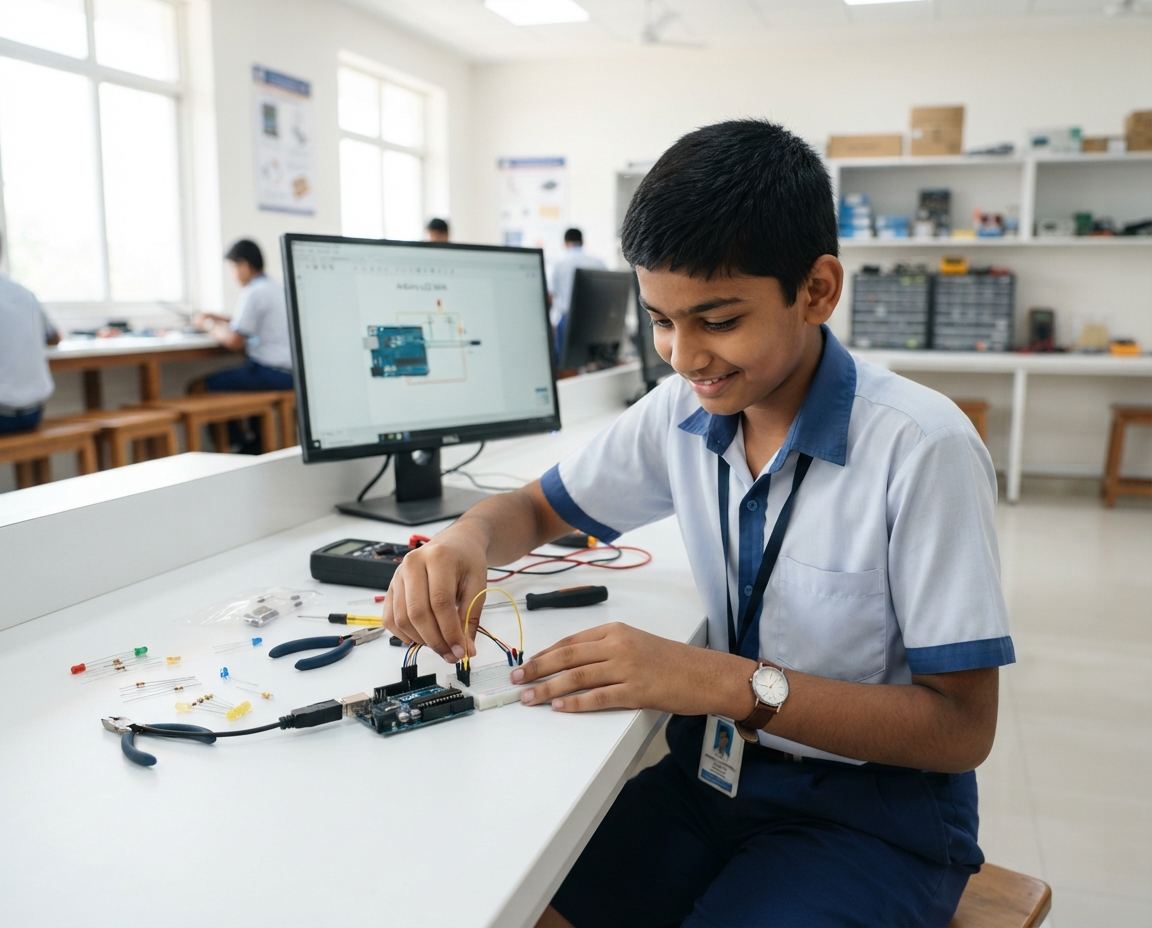
Why Colleges Are Investing in Innovation Labs
The gap between classroom theory and industry expectation is widest at college level. Recruiters routinely report that graduates know the syllabus but have never built, wired, printed or pitched anything real. An on-campus robotics and innovation lab closes that gap: students graduate with a portfolio of working projects — autonomous robots, IoT devices, 3D-printed prototypes, app-driven automations — and the confidence that comes from having debugged real hardware at 9 pm before a demo.
For the institution, the lab pays for itself in visibility. It strengthens placement conversations, gives substance to admissions marketing, supports accreditation quality narratives, and creates a natural home for hackathons, project exhibitions and industry tie-ups. Regulators are pushing the same direction — from NEP 2020's emphasis on experiential learning in higher education to AICTE's promotion of idea labs and innovation councils on technical campuses.
The AMAZEHEADS college program delivers this without burdening your faculty: instructors, equipment, electrical installation and curriculum arrive as one managed package, priced per student under a long-term partnership.
Program Tracks at College Depth
Advanced Robotics
Autonomous navigation, obstacle detection, line-following and manipulator projects on microcontroller and single-board-computer platforms — from fundamentals to competition builds.
Electronics & Embedded Systems
Circuit design, sensor integration, motor control and embedded programming — the practical core of mechatronics and IoT engineering.
Coding & Applied Software
Python and C-family programming applied to hardware, data and automation projects rather than toy exercises.
3D Printing & Prototyping
CAD-to-print workflows for enclosures, mechanical parts and product prototypes — rapid iteration skills for engineering projects.
AR/VR Development
Building immersive experiences and understanding the pipeline behind AR/VR products — one of the fastest-growing skill areas in industry.
Entrepreneurship & Finance
The Young Entrepreneurs Program and financial literacy modules at college depth: business models, customer discovery, pitching, and personal finance for first-salary years.
What the Partnership Includes
Complete Lab Setup
Equipment, worktables, storage and full electrical installation — a working lab, not a delivery of boxes.
Program Instructors
Trained instructors run scheduled sessions and mentor project work — no additional faculty hiring required.
Structured Curriculum
Semester-mapped modules across all tracks, updated regularly as industry trends move.
All-Student Implementation
Designed to cover the full intake rather than a small club — with flexible per-student pricing to match.
Events & Competitions
Support for hackathons, project exhibitions and inter-college competitions that put the lab at the centre of campus life.
Local Accountability
CBM IMPEX, the Authorised Channel Partner, coordinates everything from Bengaluru — demos, agreements, service and reviews.
Which Institutions Benefit Most
PU colleges use the innovation lab to differentiate in a crowded admissions market and to give science students a practical edge before engineering and medical entrance journeys. Commerce streams take the entrepreneurship and financial literacy tracks — often the first time these students build and pitch something real.
Degree colleges (BSc, BCA, BBA) map lab modules to skill-development and add-on course requirements. A BSc student who has built IoT sensors and a BCA student who has programmed physical robots interview very differently from peers who have only seen slides.
Engineering colleges and polytechnics use the lab as a first-year foundry and a project incubator for later semesters. It complements existing department labs by adding cross-disciplinary platforms — robotics kits, 3D printing, AR/VR — plus dedicated instructors who mentor projects across branches. Campuses pursuing innovation-council and idea-lab initiatives get a running facility instead of a proposal document.
Teacher-training and B.Ed colleges adopt the lab so future teachers graduate comfortable with the experiential methods NEP 2020 expects them to use in classrooms.
Rollout on Campus: From MoU to Working Lab
The college rollout follows the same four-step path as our school program, adjusted for semester calendars. It begins with a faculty demo — a hands-on session for the principal, HoDs and interested faculty. Next comes a customised proposal covering per-student pricing for your intake, the track mix (a robotics-heavy configuration for technical campuses; an entrepreneurship-forward one for commerce colleges), and the lab plan for your allocated room. On signing, setup — furniture, equipment, and complete electrical installation — is completed between terms, typically in 3-5 weeks. Then the program runs: timetabled sessions, project mentoring hours, semester reviews with management, and equipment maintenance handled continuously by the program team.
Because the agreement is a long-term partnership, the lab compounds: first-year students who learn fundamentals become third-year students building competition entries and final-year students shipping capstone projects — with the same instructors who taught them the basics.
Also see: robotics labs for schools, the full Innovation Lab program, Atal Tinkering Lab setup, STEM labs, computer lab setup and smart classroom solutions for lecture halls. For science departments, our science lab setup service covers physics, chemistry and biology labs.
Frequently Asked Questions
Does the Amaze Heads program work for colleges as well as schools?
Yes. AMAZEHEADS — Inspiring Young Minds is a turnkey Innovation Lab program for schools and colleges. For colleges, the same eight tracks are delivered at higher depth — advanced robotics platforms, embedded systems, 3D printing for engineering prototyping, AR/VR development, and structured entrepreneurship modules.
How is a college robotics lab priced?
Like the school program, the college program works on flexible per-student pricing charged per month or per annum under a long-term partnership — covering lab setup, electrical installation, equipment and program instructors. Contact CBM IMPEX for a proposal based on your intake.
Can the lab support final-year projects and hackathons?
Yes. Once the lab is running, students use it for course projects, mini and major projects, hackathons and competition preparation. The program's instructors mentor project work, and equipment is maintained and restocked continuously.
We are a PU college, not an engineering college. Is this relevant?
Very much. PU and degree colleges use the innovation lab to give science and commerce students hands-on exposure — robotics and electronics for science streams, entrepreneurship and financial literacy for commerce — strengthening placements, admissions marketing and NAAC/NBA-style quality narratives.
What space does a college innovation lab need?
A standard classroom or seminar hall (600-1,500 sq ft) is sufficient for most programs. The team handles layout, furniture, equipment and electrical installation; larger makerspace configurations can be designed for engineering campuses.
Can the college combine this with existing labs?
Yes. The innovation lab complements existing physics, electronics and computer labs rather than duplicating them — it adds project-based platforms (robotics kits, 3D printers, AR/VR, IoT) and, critically, dedicated instructors and a structured innovation curriculum.
Build an Innovation Lab on Your Campus
Advanced robotics, prototyping and entrepreneurship — fully managed, with flexible per-student pricing for colleges.