Composite Science Lab Equipment for Classes 6–10
One well-zoned laboratory covering physics, chemistry, and biology — the format CBSE affiliation bye-laws accept up to Class 10, and the most cost-effective science lab a growing school can build. Designed, equipped, and installed by CBM IMPEX.
Who a Composite Lab Is For
Not every school needs three laboratories. If you teach up to Class 10 — a middle school growing year by year, a new CBSE school working toward secondary affiliation, or an established high school on the Karnataka State Board — one composite science lab meets the requirement, costs a third of a three-lab suite, and keeps all science teaching (and one lab assistant) in one room.
The CBSE Affiliation Bye-laws ask secondary schools for a composite science laboratory of roughly 9 m × 6 m — about 600 sq ft — equipped for the physics, chemistry, and biology practicals of the middle and secondary syllabus. ICSE schools and Karnataka State Board high schools have equivalent "adequately equipped science lab" norms that the same room satisfies. The moment you add Classes 11-12 science, the boards require separate subject labs — which is why we design composite labs with that upgrade in mind from day one.
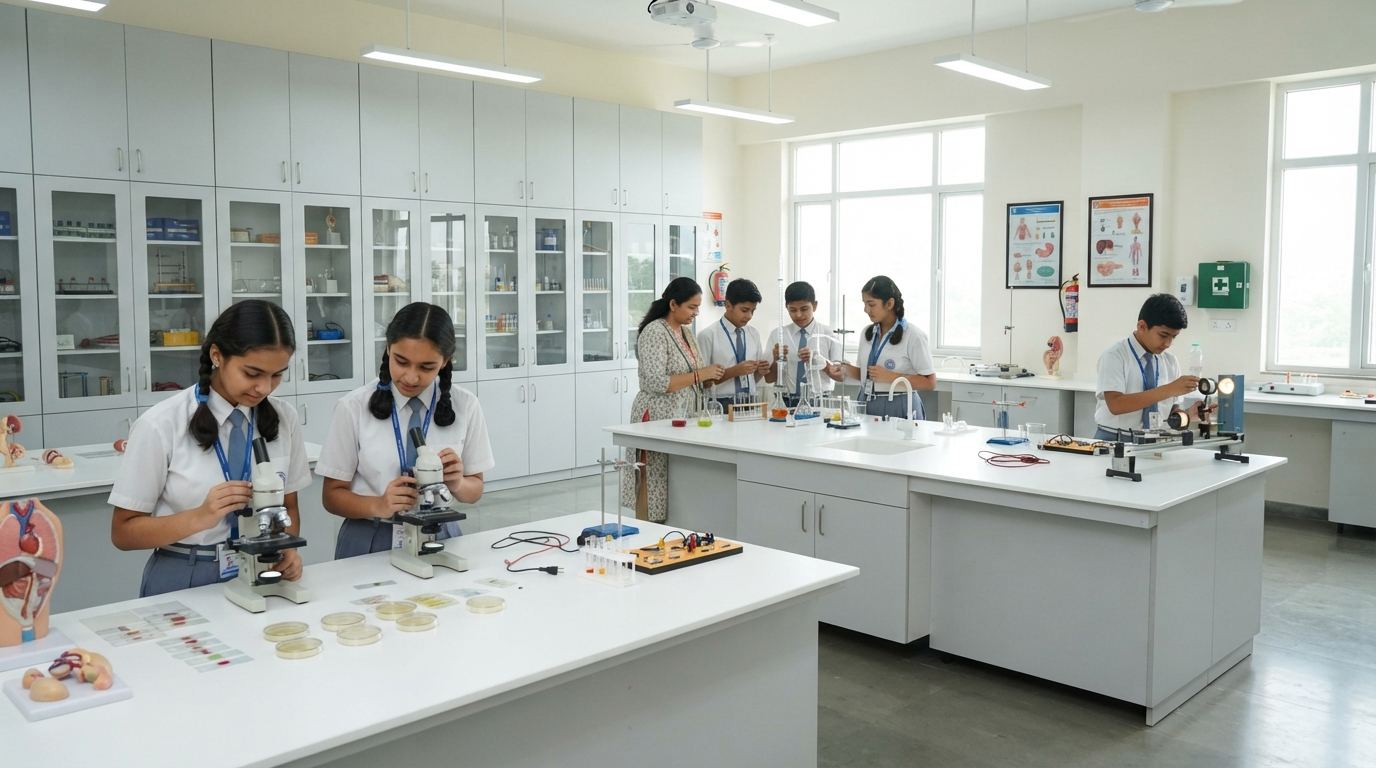
The Space Plan: One Room, Four Zones
A composite lab works when the room is zoned so wet, dry, and delicate work never fight for the same bench. Our standard 9 m × 6 m plan:
Chemistry Zone (wet wall)
Two acid-resistant benches with sinks and reagent racks along the plumbing wall, exhaust fan above, and the lockable chemical cupboard beside — so every wet, fuming activity stays in one serviced corner of the room.
Physics Zone (powered benches)
Two dry benches with RCCB-protected bench-top power points and low-voltage eliminators for electricity, magnetism, and measurement practicals — kept away from the sinks by design.
Biology Zone (light corner)
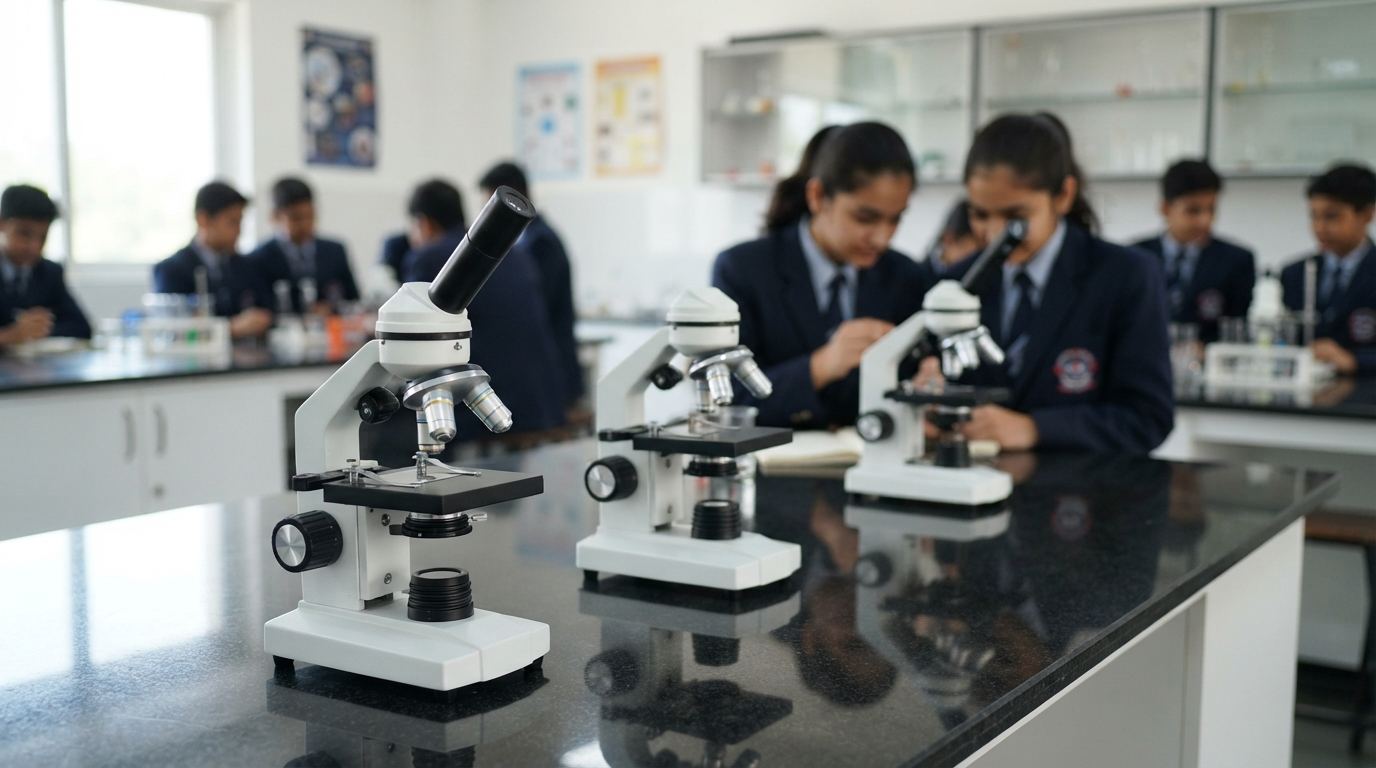
A vibration-free microscopy bench near the windows, slide and specimen storage, and wall space for the chart library — with the models cabinet doubling as the room's display case.
Demo & Storage Zone
A raised demonstration bench at the front with its own sink, gas point, and power, and a full storage wall at the back: glassware cabinet, apparatus cupboards, and the safety station (extinguisher, first-aid, eye-wash) beside the door.
Seating is typically 30-40 students on stools, with a minimum 1.2 m aisle between benches and unobstructed reach to the exit — the two things inspectors measure first.
The Shared-Equipment Strategy
A composite lab's economics come from sharing what can be shared and duplicating only what cannot:
- Shared across subjects — balances, thermometers, glassware, burners, wash bottles, stands, and the demonstration bench serve all three subjects; one purchase covers physics, chemistry, and biology practicals.
- Subject-specific but compact — measurement instruments (vernier calipers, screw gauges), a starter optics and electricity kit, microscope fleet sized to pairs-of-students, one anatomical torso and skeleton, essential slide sets, and the reagent range for secondary-level chemistry.
- Scheduled, not duplicated — a simple period-wise lab timetable lets three science teachers share the room without collisions; we provide a template with handover.
- Bought once, reused later — benches, storage, microscopes, and instruments are specified so they carry straight into the separate labs if you later add senior secondary science. Nothing is throwaway.
A typical composite lab equipment list runs 120-180 line items. We build it from your board's Class 6-10 practical syllabus and share it itemised with the quotation, so your management sees exactly where every rupee goes.
Indicative Composite Lab Budgets
| Setup Level | What It Covers | Indicative Budget* |
|---|---|---|
| Compact composite lab (up to Class 8) | 4 benches, starter kits for all three subjects, safety package, installation | ₹4.5 – 6.5 lakh |
| Full composite lab (up to Class 10, CBSE norm room) | Zoned 600 sq ft layout, complete secondary-syllabus equipment, chemical storage, safety package, installation, orientation | ₹6 – 9 lakh |
| Composite-plus (pre-senior-secondary) | Full composite lab with senior-grade benches and storage sized for later conversion to a subject lab | ₹8 – 10 lakh |
* Indicative ranges for 30-40 student batches, including furniture, equipment, chemicals, safety gear, and installation; civil work excluded. Request an itemised quotation for your room.
Frequently Asked Questions
What is a composite science lab?
A single laboratory room equipped and zoned to teach physics, chemistry, and biology practicals for middle and secondary classes (typically Classes 6-10). It combines a wet chemistry zone with sinks and chemical storage, a powered physics zone, a biology microscopy corner, and a demonstration bench — instead of three separate rooms.
Is a composite lab enough for CBSE affiliation?
Yes, up to secondary level. The CBSE Affiliation Bye-laws require schools affiliated up to Class 10 to have a composite science laboratory of roughly 9 m x 6 m (about 600 sq ft). Separate physics, chemistry, and biology labs become mandatory only when the school offers the science stream at Classes 11-12.
How much does a composite science lab cost?
Indicatively Rs. 4.5-9 lakh depending on room size and equipment depth: about Rs. 4.5-6.5 lakh for a compact lab serving up to Class 8, and Rs. 6-9 lakh for a full CBSE-norm 600 sq ft lab equipped for the complete secondary syllabus — including furniture, equipment, chemicals, safety gear, and installation, excluding civil work. Quotations are itemised line by line.
What room size does a composite lab need?
The CBSE norm is roughly 9 m x 6 m (600 sq ft), which seats 30-40 students comfortably with four zones and safe aisle widths. Smaller rooms can work for smaller batches — we have built effective composite labs in 450 sq ft — but below that, batch sizes or the equipment plan must shrink accordingly. We confirm feasibility from your room dimensions before quoting.
Can a composite lab be upgraded to separate labs later?
Yes — and it should be planned that way. We specify benches, storage, microscopes, and instruments that carry directly into the separate physics, chemistry, or biology labs when you add senior secondary science. Typically the composite room becomes the chemistry lab (it already has the plumbing and ventilation), and the physics and biology equipment moves to two new rooms.
Does a composite lab need a fume hood?
For Classes 6-10 practicals, a well-ventilated chemistry zone with an exhaust fan is generally acceptable, since secondary-level chemistry avoids the heavy fuming work of the senior syllabus. If your school plans to add Classes 11-12 within a few years, we recommend provisioning the duct route (and optionally the hood) during the composite build — it is much cheaper than retrofitting.
Plan Your Composite Science Lab
Send your room dimensions, board, and highest class — we will reply with a zoned layout and an itemised quotation within 2-3 working days.