
Equipment for a Physics Lab: Complete List
Every instrument a school physics laboratory needs — measurement, mechanics, optics, heat and sound, electricity and magnetism, and Class 12 electronics — with suggested quantities for a 30-student batch, indicative price bands, and the bench wiring the apparatus depends on. CBM IMPEX supplies, installs and restocks the whole list on one GST invoice.
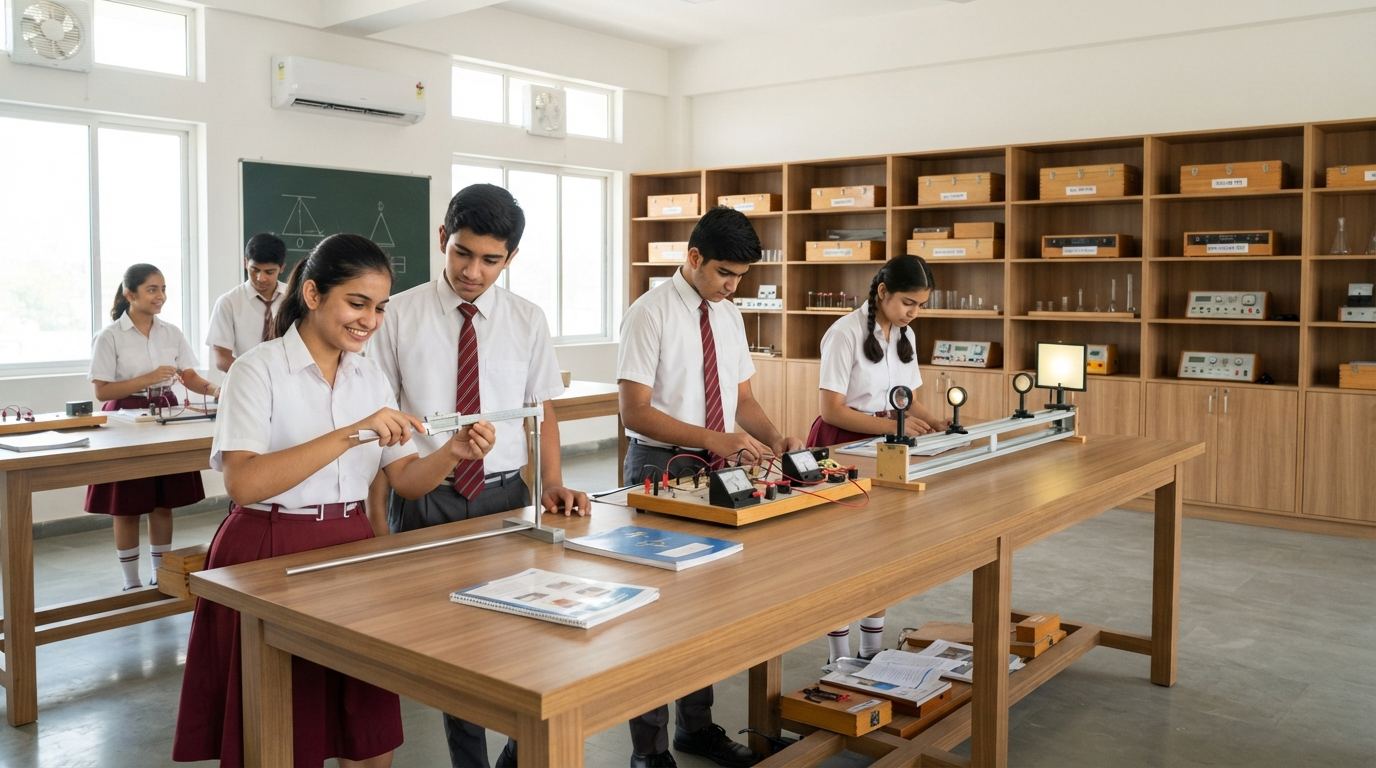
How Physics Lab Equipment Is Grouped
A physics lab is less about plumbing and fumes than about precision instruments, stable benches and electricity delivered safely to every working position. The apparatus splits into six families, and a lab that can run the full practical syllabus needs all six in class-set quantities — typically 15 working sets for a 30-student batch working in pairs, with the bulky and expensive items shared on rotation.
Measurement instruments
Vernier calipers, micrometer screw gauges, spherometers, travelling microscope, balances, metre scales and stop clocks — the instruments every other experiment depends on.
Mechanics and properties of matter
Clamp stands, pendulum and spring sets, slotted masses, parallelogram of forces board, friction planes, Searle’s apparatus, capillary and viscosity sets.
Optics
Optical benches with uprights and pins, lens and mirror sets, prisms and glass slabs, spectrometer with sodium lamp, and a dark corner for image work.
Heat and sound
Calorimeters, thermometers, heating arrangements, thermal conductivity apparatus, sonometer, resonance tube and tuning fork sets.
Electricity and magnetism
Metre bridges, potentiometers, galvanometers, ammeters and voltmeters, resistance boxes, rheostats, regulated DC supplies and magnetometers.
Modern physics and electronics
Diode, Zener and transistor characteristic boards, logic gate trainers, multimeters, and for deeper labs an oscilloscope, function generator and data loggers.
Measurement Instruments
Buy these first and buy them well. Every graph a student plots inherits the least count of the instrument that produced it, so accuracy class here decides the quality of every other practical in the lab.
| Instrument | Typical specification | Qty per 30-student batch | Indicative price band* |
|---|---|---|---|
| Vernier caliper | Least count 0.02 mm, stainless steel (0.01 mm digital optional) | 15 | ₹350 – 900 |
| Micrometer screw gauge | Least count 0.01 mm, range 0–25 mm | 15 | ₹450 – 1,200 |
| Spherometer | Least count 0.01 mm, three-leg with disc | 15 | ₹400 – 900 |
| Travelling microscope | Vernier 0.01 mm, horizontal and vertical travel | 2 – 4 | ₹12,000 – 28,000 |
| Physical balance with weight box | Beam balance, fractional weight set | 2 | ₹3,500 – 9,000 |
| Electronic balance | 0.01 g readability, 500 g capacity | 1 – 2 | ₹6,000 – 18,000 |
| Metre and half-metre scales | Hardwood or steel, mm graduations | 30 | ₹60 – 200 |
| Stop clocks / digital stopwatches | 0.1 s or better | 15 | ₹250 – 800 |
| Screw gauge and caliper test pieces | Wires, glass slabs, spheres for measurement practicals | 15 sets | ₹150 – 600 |
* Indicative per-unit bands for planning and budget approval only, exclusive of taxes and freight. Actual rates depend on make, accuracy class and order quantity — we quote every line individually.
Mechanics and Properties of Matter
| Apparatus | Typical specification | Qty per 30-student batch | Indicative price band* |
|---|---|---|---|
| Simple pendulum set | Bobs, thread, split cork, clamp stand | 15 | ₹250 – 800 |
| Clamp stands with boss heads | Cast-iron base, 750 mm rod | 15 | ₹350 – 900 |
| Helical springs and slotted mass sets | Spring constants for oscillation practicals; 50 g slotted masses | 15 | ₹300 – 1,100 |
| Spring balances | 0.5 kg, 1 kg, 5 kg ranges | 15 | ₹120 – 400 |
| Parallelogram of forces apparatus | Gravesand’s board with pulleys and weights | 10 | ₹1,200 – 3,500 |
| Friction apparatus | Inclined plane with wooden block and pulley | 10 | ₹900 – 2,800 |
| Young’s modulus (Searle’s) apparatus | Twin-wire frame with micrometer and hanger | 6 – 8 | ₹2,500 – 7,000 |
| Surface tension and viscosity set | Capillary tubes, travelling microscope stand, viscosity column with steel balls | 6 – 8 | ₹1,500 – 5,000 |
| Bernoulli / flow apparatus | Venturi and flow demonstration set | 1 – 2 | ₹3,000 – 9,000 |
| Vernier-fitted metre bridge trolley set | Dynamics trolleys, ticker timer and tape | 6 – 8 | ₹1,800 – 5,500 |
* Indicative per-unit bands for planning and budget approval only, exclusive of taxes and freight. Actual rates depend on make, accuracy class and order quantity — we quote every line individually.
Optics Equipment
Optical benches are the single biggest line in a physics apparatus order after microscopy-grade instruments. Eight to ten benches let a 30-student batch work in pairs across two rotations; store them horizontally on a rack so the rails stay true.
| Apparatus | Typical specification | Qty per 30-student batch | Indicative price band* |
|---|---|---|---|
| Optical bench | 1.5 m bench, four uprights, needle and pin sets | 8 – 10 | ₹4,500 – 12,000 |
| Convex and concave lens set | Assorted focal lengths, 50 mm aperture | 15 | ₹600 – 1,800 |
| Concave and convex mirrors | Mounted, assorted radii | 15 | ₹350 – 1,200 |
| Glass prism | Equilateral, 38 mm face, crown glass | 15 | ₹180 – 500 |
| Rectangular glass slab | For lateral displacement and refractive index | 15 | ₹120 – 400 |
| Spectrometer | Prism table, telescope and collimator, vernier scales | 2 – 4 | ₹14,000 – 45,000 |
| Sodium vapour lamp with choke | For spectrometer and Newton’s rings work | 1 – 2 | ₹4,500 – 12,000 |
| Newton’s rings apparatus | Plano-convex lens, glass plate and holder | 2 – 4 | ₹3,000 – 9,000 |
| Ray optics kit and drawing board set | Pins, drawing boards, protractors | 15 | ₹300 – 1,000 |
| Blackout curtains / dark-room provision | Optics corner with independent lighting | 1 room | ₹8,000 – 30,000 |
* Indicative per-unit bands for planning and budget approval only, exclusive of taxes and freight. Actual rates depend on make, accuracy class and order quantity — we quote every line individually.
Heat and Sound Apparatus
| Apparatus | Typical specification | Qty per 30-student batch | Indicative price band* |
|---|---|---|---|
| Calorimeter with stirrer | Copper vessel with insulating jacket | 10 | ₹350 – 900 |
| Laboratory thermometers | −10 to 110 °C and 0 to 360 °C | 15 each | ₹120 – 500 |
| Heating arrangement | Bunsen burner or hot plate with stand and gauze | 10 – 15 | ₹250 – 3,000 |
| Thermal conductivity / Searle’s apparatus | Metal bar with thermometer wells and steam chamber | 2 – 4 | ₹4,000 – 12,000 |
| Sonometer with weights | Steel wire, movable bridges, hanger set | 4 – 6 | ₹2,500 – 6,000 |
| Resonance tube apparatus | Tube with reservoir, stand and scale | 4 – 6 | ₹2,800 – 7,000 |
| Tuning fork sets | 256–512 Hz, eight forks with rubber pad | 4 sets | ₹900 – 2,500 |
| Steam generator / boiler | For latent heat and conductivity work | 2 | ₹2,000 – 6,000 |
* Indicative per-unit bands for planning and budget approval only, exclusive of taxes and freight. Actual rates depend on make, accuracy class and order quantity — we quote every line individually.
Electricity and Magnetism Apparatus
Roughly half the examined Class 12 practical list is electrical, which makes this the deepest part of the order — and the part where quantities matter most, because a circuit practical occupies a working position for the whole period.
| Apparatus | Typical specification | Qty per 30-student batch | Indicative price band* |
|---|---|---|---|
| Metre bridge with jockey | Wheatstone form, with standard resistance coils | 10 | ₹1,200 – 3,000 |
| Potentiometer | 10-wire, with jockey and terminals | 8 – 10 | ₹2,500 – 6,500 |
| Table galvanometer | 30-0-30 µA, pivoted, with shunt accessories | 10 | ₹900 – 2,400 |
| DC ammeters | 0–1 A, 0–3 A, 0–5 A moving coil | 15 | ₹400 – 1,200 |
| DC voltmeters | 0–3 V, 0–15 V moving coil | 15 | ₹400 – 1,200 |
| Resistance boxes | Plug type 1–100 Ω and 1–5000 Ω | 10 – 15 | ₹700 – 2,000 |
| Rheostats | Sliding, 50 Ω / 100 Ω / 350 Ω | 10 – 15 | ₹600 – 1,800 |
| Regulated DC supply / battery eliminator | 2–12 V, current limited, short-circuit protected | 10 – 15 | ₹700 – 2,200 |
| Digital multimeters | Auto-ranging, CAT II rated | 5 – 10 | ₹500 – 1,800 |
| Bar magnets, compass boxes, magnetic needles | For magnetic field and deflection magnetometer work | 15 sets | ₹250 – 900 |
| Deflection and vibration magnetometer | With bar magnet pair | 4 – 6 | ₹1,500 – 4,500 |
| Transformer and induction demonstration kit | Primary/secondary coils, soft-iron core, galvanometer | 2 – 4 | ₹2,000 – 6,000 |
| Connecting wires, plug keys, crocodile clips, sandpaper | Consumable class stock, replaced annually | 1 lot | ₹3,000 – 8,000 |
* Indicative per-unit bands for planning and budget approval only, exclusive of taxes and freight. Actual rates depend on make, accuracy class and order quantity — we quote every line individually.
Modern Physics and Electronics
| Apparatus | Typical specification | Qty per 30-student batch | Indicative price band* |
|---|---|---|---|
| Semiconductor diode characteristics board | Forward and reverse bias, with terminals or built-in meters | 5 – 8 | ₹1,500 – 4,000 |
| Zener diode regulation board | Breakdown characteristics and load regulation | 5 – 8 | ₹1,500 – 4,000 |
| Transistor characteristics kit | CE configuration, input and output curves | 5 – 8 | ₹1,800 – 5,000 |
| Logic gate trainer | AND, OR, NOT, NAND, NOR with LED indication | 5 | ₹1,800 – 5,000 |
| Cathode ray oscilloscope | Dual trace, 20–30 MHz (or digital storage) | 1 – 2 | ₹16,000 – 60,000 |
| Function generator | 1 Hz – 1 MHz, sine/square/triangle | 1 – 2 | ₹5,000 – 18,000 |
| Photocell / LDR and solar cell kit | For photoelectric and characteristic demonstrations | 4 – 6 | ₹1,200 – 4,000 |
| Data logger with sensor set | Optional digital integration — motion, temperature, light, voltage probes | 1 set | ₹25,000 – 90,000 |
* Indicative per-unit bands for planning and budget approval only, exclusive of taxes and freight. Actual rates depend on make, accuracy class and order quantity — we quote every line individually.
Power Supply and Wiring: The Part Schools Underestimate
The room’s wiring is as much a piece of physics lab equipment as the potentiometer. Our layout drawings specify:
- Bench-top power points — switched 230 V sockets at each working position, mounted on the bench spine above spill height, on a dedicated lab circuit.
- RCCB protection and earthing — the lab circuit runs through its own RCCB with verified earthing, so a shorted circuit trips the bench, not the building.
- Low-voltage DC distribution — regulated eliminators (2–12 V) at the benches so students never wire experiments to mains; a central stabilised supply is an option for larger labs.
- A master kill switch — one clearly marked switch at the teacher’s bench cuts power to every student position instantly.
- Dark-room provision — blackout curtains or a partitioned corner with independent lighting for optics practicals.
Your electrician executes the wiring to our point-by-point marking, or we bring our own contractor — either way we test and certify every bench point during commissioning.
Furniture and Storage for a Physics Lab
A physics lab needs less plumbing than a chemistry lab and more power. Only two or three sink positions are needed; what every position does need is a stable, level top and a switched socket. Bench and storage options in full are on the science lab furniture page.
| Item | Typical specification | Qty per lab | Indicative price band* |
|---|---|---|---|
| Student workbench | Laminate or epoxy top with power spine; seats 6–8, no plumbing needed at every position | 4 – 5 per 32-student lab | ₹22,000 – 60,000 each |
| Demonstration table | Teacher bench with switched power and storage | 1 | ₹22,000 – 55,000 |
| Instrument storage cupboard | Glazed, adjustable shelves, lockable | 3 – 4 | ₹12,000 – 35,000 |
| Optical bench rack / trolley | Horizontal storage so benches stay true | 1 – 2 | ₹8,000 – 22,000 |
| Laboratory stools | 600–750 mm, MS frame | 32 | ₹900 – 2,500 |
| Safety set | Fire extinguisher, first-aid box, master kill switch signage | 1 per lab | ₹5,000 – 14,000 |
* Indicative per-unit bands for planning and budget approval only, exclusive of taxes and freight. Actual rates depend on make, accuracy class and order quantity — we quote every line individually.
Mapped to CBSE Class 11–12 Physics Practicals
| Class | Practical area | Key equipment supplied |
|---|---|---|
| Class 11 | Measurement — vernier, screw gauge, spherometer | Vernier calipers, micrometer screw gauges, spherometers, glass slabs, wires |
| Class 11 | Simple pendulum and spring oscillations | Pendulum bobs, clamp stands, stop clocks, slotted masses, helical springs |
| Class 11 | Force, friction and equilibrium | Gravesand’s board, friction planes, spring balances, pulleys |
| Class 11 | Young’s modulus, surface tension, viscosity | Searle’s apparatus, travelling microscope, capillary tubes, viscosity columns |
| Class 11 | Sound and heat | Sonometer, resonance tube, tuning forks, calorimeters, thermometers |
| Class 12 | Ohm’s law, metre bridge, potentiometer | Metre bridges, potentiometers, resistance boxes, rheostats, eliminators, ammeters, voltmeters |
| Class 12 | Galvanometer figure of merit and conversion | Table galvanometers, shunt resistances, half-deflection accessories |
| Class 12 | Optics — focal lengths, prism, refractive index | Optical benches, lens and mirror sets, prisms, pins, travelling microscope, glass slabs |
| Class 12 | Semiconductors and logic gates | Diode and Zener boards, transistor kits, logic gate trainers, multimeters |
ICSE, ISC and Karnataka PU practical lists overlap heavily with this; we adjust instrument ranges and quantities to the board you follow, and include the examiner-station spares that board practical exams require.
What Each Stage Needs
A physics lab for Classes 9–10 and one for Classes 11–12 are different purchases, not different sizes of the same purchase. The list deepens at senior secondary because the practicals are examined and each student needs a working position.
| Stage | Lab format | Core physics equipment | Indicative budget* |
|---|---|---|---|
| Classes 6–8 | Physics zone in a science room, demonstration-led | Magnets and compasses, simple circuits, pulleys and levers, spring balances, metre scales, ray boxes, tuning forks | ₹60,000 – 1.5 lakh |
| Classes 9–10 | Physics zone inside a composite lab | Vernier calipers and screw gauges, Ohm’s law kits, ammeters and voltmeters, ray optics sets, spring and pendulum work | ₹1.5 – 3 lakh |
| Classes 11–12 (single section) | Separate physics lab, examined practicals | Full measurement set, optical benches, metre bridges, potentiometers, galvanometers, semiconductor boards, bench power | ₹5 – 8 lakh |
| Classes 11–12 (multiple sections) | Physics lab with depth and spares | Above plus spectrometer, oscilloscope, function generator, digital instruments, dark room and examiner-station spares | ₹8 – 12 lakh |
* Indicative totals including furniture, apparatus and installation; civil work excluded.
Indicative Physics Lab Budgets
| Setup level | What it covers | Indicative budget* |
|---|---|---|
| Physics zone in a composite lab (Classes 6–10) | Benches, measurement instruments, basic electricity and optics kits | ₹1.5 – 3 lakh (as part of the composite lab) |
| Standard senior secondary physics lab | Full furniture, complete CBSE Class 11–12 instrument sets, bench wiring, installation | ₹5 – 8 lakh |
| Advanced or multi-section lab | Deeper instrument sets, spectrometer, oscilloscope, digital instruments, dark room, spares | ₹8 – 12 lakh |
* Indicative ranges for a typical 30–40 student batch, excluding civil and primary electrical work. Request an itemised quotation for exact pricing.
Frequently Asked Questions
What equipment is required for a physics lab?
A physics lab needs six groups of equipment. Measurement instruments: vernier calipers, micrometer screw gauges, spherometers, a travelling microscope, balances, metre scales and stop clocks. Mechanics: clamp stands, pendulum sets, springs and slotted masses, a parallelogram of forces board, friction planes and Searle's apparatus. Optics: optical benches with uprights, lens and mirror sets, prisms and glass slabs, and a spectrometer with a sodium lamp for senior work. Heat and sound: calorimeters, thermometers, a sonometer, a resonance tube and tuning fork sets. Electricity and magnetism: metre bridges, potentiometers, galvanometers, ammeters and voltmeters, resistance boxes, rheostats and regulated DC supplies. Modern physics and electronics: diode, Zener and transistor characteristic boards, logic gate trainers, a multimeter set and, for deeper labs, an oscilloscope.
How many sets of physics apparatus does a 30-student batch need?
Plan on students working in pairs, so 15 sets of the individually used instruments: vernier calipers, screw gauges, spherometers, stop clocks, meters and ray optics sets. Bulkier apparatus is shared and rotated: eight to ten optical benches, eight to ten potentiometers, ten metre bridges. Single expensive instruments such as a spectrometer, oscilloscope or travelling microscope are supplied in ones and twos for the teacher station and rotation. Add two or three spares of the items that break or drift most, and remember that board practical exams need working examiner stations on the day.
How much does equipment for a school physics lab cost?
As indicative planning bands: a physics zone inside a composite lab for Classes 9-10 is about Rs. 1.5 to 3 lakh; a standard senior secondary physics lab for a single section is Rs. 5 to 8 lakh including furniture, the full instrument set, bench wiring and installation; and a deeper multi-section lab with a spectrometer, oscilloscope and digital instruments runs Rs. 8 to 12 lakh. Civil work and primary electrical supply are excluded. The instrument list itself is usually 55 to 65 per cent of the total, furniture most of the rest.
What does a CBSE physics lab need that a Class 10 lab does not?
Three things. First, precision: examined Class 11-12 practicals are marked on readings, so least counts and calibration matter in a way they do not at Class 10. Second, electrical infrastructure: half the Class 12 practical list is electrical, so the room needs bench-top switched sockets on a dedicated RCCB-protected circuit, low-voltage regulated DC at each position and a master kill switch. Third, optics depth: optical benches in class-set quantities and a dark corner or blackout curtains, plus a spectrometer and sodium lamp for the senior experiments.
How is an ICSE or ISC physics lab different?
The apparatus families are the same; the quantities and emphases differ. ISC practical work places more weight on individual workstations during examinations, so the count of working sets of the examined apparatus matters more than the breadth of the catalogue. Karnataka PU follows a similar pattern for PCMB and PCMC combinations. We adjust instrument ranges and quantities to the board you follow and include the examiner-station spares that practical exams require.
What wiring and power does a physics lab need?
A dedicated lab circuit protected by its own RCCB with verified earthing; switched 230 V sockets at each working position mounted on the bench spine above spill height; regulated 2-12 V DC eliminators at the benches so students never wire experiments to mains; and one clearly marked master kill switch at the teacher's bench that cuts every student position at once. We mark the points on the layout drawing and test and certify each bench point at commissioning.
Do you supply physics apparatus without furniture or installation?
Yes. Many schools already have benches and need only the apparatus, in which case we quote the instrument list line by line and deliver against a single GST invoice. Schools building a new block more often hand us the empty room and take back a commissioned lab with benches, wiring, storage, apparatus and safety equipment in place.
Do you replace broken apparatus and recalibrate instruments?
Yes. Annual replenishment covers the consumable and high-breakage items - connecting wires, plug keys, thermometers, glass components - and schools on a maintenance contract also get instrument servicing, meter checks and a pre-inspection audit before board visits.
Related Equipment Lists
- Science lab equipment for schools — the full physics, chemistry and biology lists in one place
- Chemistry lab equipment list · biology lab equipment list
- Composite science lab — one lab covering all three subjects for Classes 6–10
- Science lab furniture · school lab furniture
- Robotics lab for schools · computer lab setup
Get an Itemised Physics Lab Quotation
Send your board, the classes you teach and your room dimensions. We will return a line-by-line apparatus list with quantities and prices, plus a bench and power layout for the room, within 2–3 working days.