
Maths Lab for Schools: Equipment List, Setup & CBSE Requirements
Everything a school needs to plan a mathematics laboratory: the equipment grouped by topic with quantities for a 30–40 student batch, what each class actually uses, what CBSE asks for, and how to lay out the room. CBM IMPEX supplies and sets up school maths labs across Bengaluru and Karnataka.
What Is a Maths Lab?
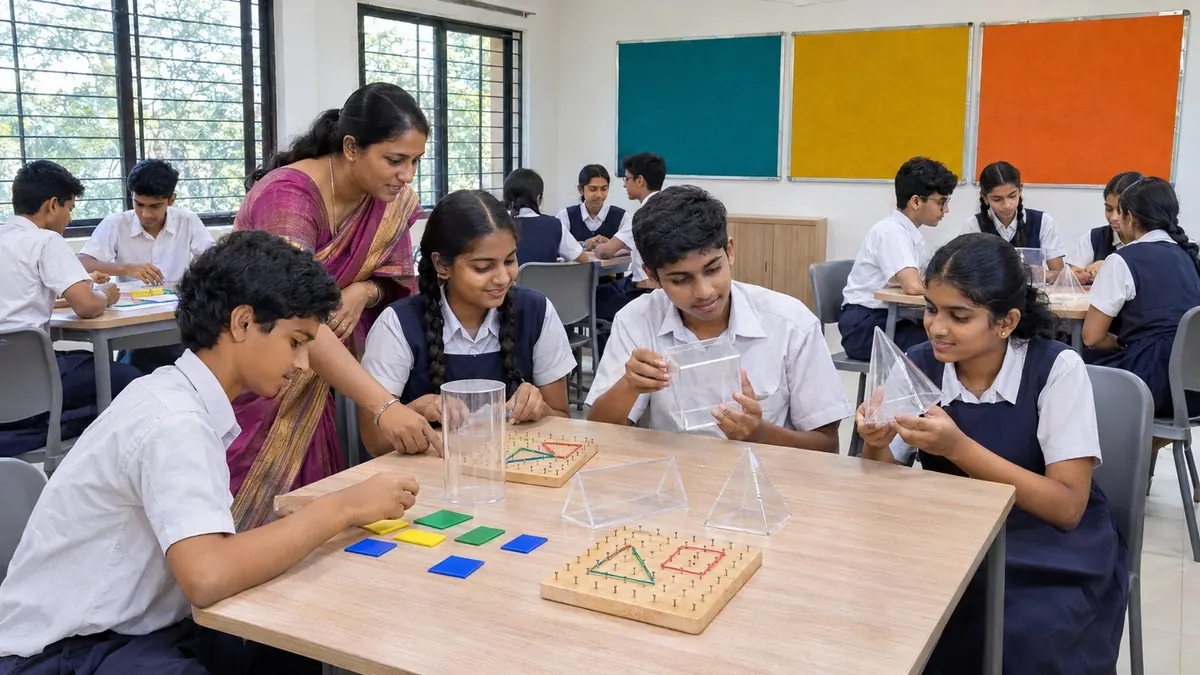
A maths lab is a room where students learn mathematics by doing it. They fold, cut, measure, plot and build, and they verify an identity or a theorem with their own hands before they meet the proof. CBSE’s guidelines describe it as a room holding “different kinds of materials and teaching/learning aids, needed to help the students understand the concepts through relevant, meaningful and concrete activities”.
For a school, that means buying three things: models and manipulatives for each area of the syllabus, measuring and drawing instruments, and the furniture, storage and display walls that let 30–40 students work in groups. The list below covers all three. Each item is mapped to CBSE’s own maths lab list and to the NCERT activities that are now marked in internal assessment.
- Room: CBSE’s affiliation bye-laws ask for a separate maths lab at least the size of a regular classroom. Its maths lab SOP sets a 500 sq ft minimum and 40 seats.
- Marks: in the 2026–27 CBSE curriculum, Classes 9 and 10 carry a 5-mark lab practical and Classes 11 and 12 carry 10 marks for mathematics activities.
- Activities: NCERT’s laboratory manuals set out 34 activities for Class 9, 32 for Class 10, 33 for Class 11 and 27 for Class 12.
Equipment list
Fifty-plus items in eight groups, each with its use and a quantity for a 30–40 student batch.
Maths lab equipment list →Class-wise kits
What primary, middle, secondary and senior secondary classes actually use, from the NCERT manuals.
Kits by class →CBSE requirements
The bye-law clause, the affiliation SOP, the circulars and the current marking scheme, with links to each.
CBSE maths lab rules →Layout & setup
Room size, zones, furniture and storage, and how we survey, supply and install the lab.
Room layout →Maths Lab Equipment List
Grouped by area of the syllabus, with the use of each item and a suggested quantity.
Quantities assume a batch of 30–40 students working in eight groups of four or five, plus one demonstration set for the teacher. The last column shows whether the item appears in CBSE’s maths lab SOP. That list is a minimum, mostly one of each item, which is enough for a teacher to demonstrate. If every group is to work at the same time, buy the group quantities shown here. We quote every line separately: itemised quote on request.
Number and arithmetic
| Item | What it is used for | Suggested qty (30–40 students) | In CBSE SOP |
|---|---|---|---|
| Abacus | Place value, counting, and addition and subtraction with carrying | 8–10 student abacuses + 1 large demonstration abacus | Yes |
| Base-ten (Dienes) blocks | Units, rods and flats for place value and regrouping | 8 sets | Yes (primary kit) |
| Place-value cards (whole numbers and decimals) | Building and reading four- to six-digit numbers and decimals | 8 sets | Yes (primary kit) |
| Napier’s bones | Multiplication with lattice rods, and a link to the history of calculation | 8 sets | — |
| Wall number line and integer boards | Ordering numbers, and adding and subtracting integers | 1 wall number line + 8 integer boards | Yes (integer board) |
| Fraction kit (circles and strips) | Equivalent fractions, and adding and subtracting fractions | 8–10 kits | Yes |
| Decimal kit | Tenths and hundredths, and the link between fractions and decimals | 8 kits | Yes (primary kit) |
| Play-money kit | Money, bills and shopping problems for primary classes | 4–8 kits | Yes (primary kit) |
| Unit cubes (wooden or plastic) | Counting, volume, and the sum-of-squares pattern in Class 11 | 200–500 cubes | Yes |
Algebra
| Item | What it is used for | Suggested qty (30–40 students) | In CBSE SOP |
|---|---|---|---|
| Algebraic identity kit | Area models for (a+b)², (a−b)² and a²−b² | 8 kits | Yes (identity models) |
| Cube identity models | 3-D models for (a+b)³, (a−b)³ and a³±b³, as in the NCERT Class 9 activities | 2–4 sets | — |
| Algebra tiles | Multiplying and factorising polynomials | 8 sets | — |
| Magnetic coordinate (graph) board with markers | Plotting points, lines and the graphs of linear and quadratic equations | 1 teacher board + graph paper for students | Yes |
| Square-root spiral board | Constructing √2, √3 and so on, and placing them on the number line (Class 9) | 1–2 | — |
| Pascal’s triangle board | Binomial expansion and number patterns (Class 11) | 1–2 | — |
Geometry and mensuration
| Item | What it is used for | Suggested qty (30–40 students) | In CBSE SOP |
|---|---|---|---|
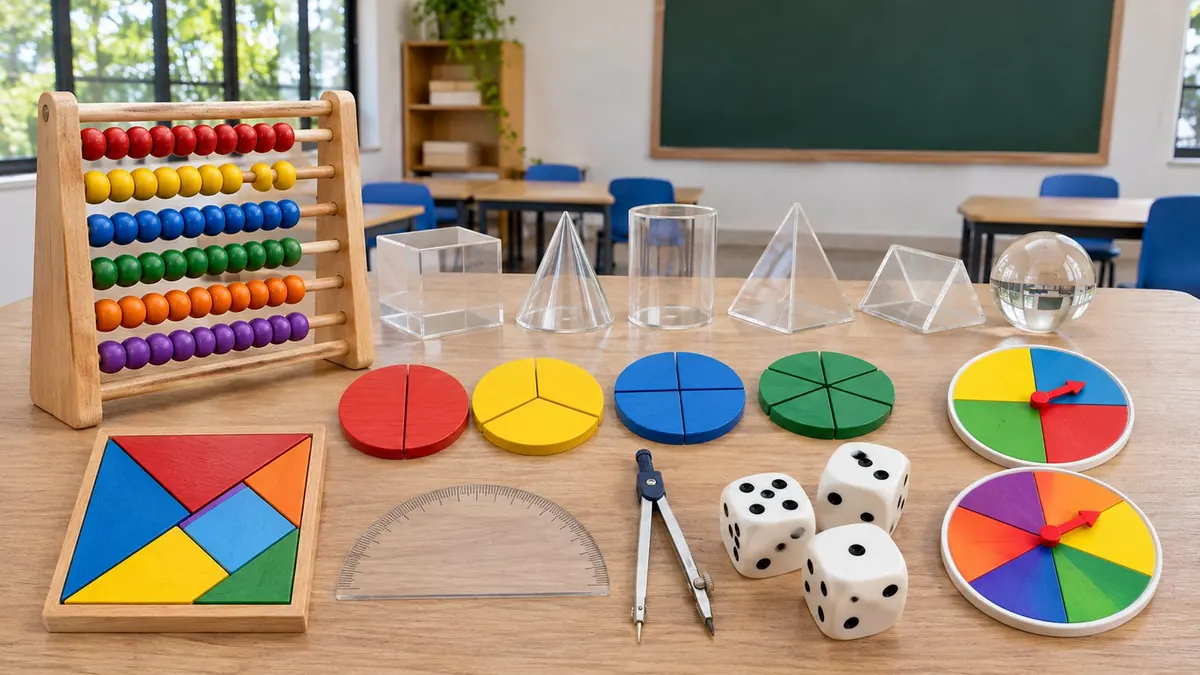
| Geometrical solids set | Faces, edges, nets, surface area and volume of cubes, cuboids, cylinders, cones and spheres | 2 sets (one hardwood, one transparent acrylic) | Yes |
| Platonic solids, prisms and pyramids | Polyhedra and Euler’s formula | 1–2 sets | Yes |
| Volume relationship set | Comparing the volumes of a cone, a hemisphere and a cylinder of equal radius and height | 2 sets | Yes |
| Mensuration kit | Areas of plane figures and surface areas of solids | 2–4 kits | Yes |
| Pythagoras theorem model | Verifying a² + b² = c² with square cut-outs | 2–4 | Yes |
| Triangle kit | Angle sum, exterior angle, congruence and similarity | 8 | Yes |
| Circle concept kit | Angles in a segment, cyclic quadrilaterals and tangents | 2–4 | Yes |
| Geoboards (square and circular) | Area by counting squares, shapes, and angles in a circle | 15–20 (one per pair) | Yes (circular geoboard) |
| Tangram sets | Shapes, conservation of area and spatial reasoning | 15–20 | Yes |
| Tessellation kit and shape stencils | Tiling, symmetry and pattern work | 8 kits + 1 set of stencils | Yes |
| Conic sections model | The circle, ellipse, parabola and hyperbola as sections of a cone (Class 11) | 1 | Chart only |
| 3-D coordinate (octant) model | Points in space, octants and distances in three dimensions (Classes 11–12) | 1–2 | — |
Trigonometry
| Item | What it is used for | Suggested qty (30–40 students) | In CBSE SOP |
|---|---|---|---|
| Clinometer | Measuring the angle of elevation to find the height of a building or tree (Class 10) | 2–4 | Yes (2) |
| Sextant | Measuring angles between distant points for heights-and-distances projects | 2 for field work (the SOP lists 8) | Yes (8) |
| Unit-circle trigonometry model | Sine and cosine values in all four quadrants, using a 0–360° protractor (Class 11) | 1–2 | — |
| Trigonometry charts | Ratios, standard angles and identities | 1 set | Yes (chart) |
Data and probability
| Item | What it is used for | Suggested qty (30–40 students) | In CBSE SOP |
|---|---|---|---|
| Probability kit (dice, coins of different colours, playing cards) | Experimental and theoretical probability. The NCERT Class 10 activities have students throw a die 500 times and toss a coin 1,000 times. | 10 kits (one per group, plus spares) | Yes |
| Spinners | Equal and unequal outcomes, and simple probability distributions | 10 | — |
| Pairs of dice and numbered counters | Sample spaces and conditional probability (Classes 11–12) | 10 sets | — |
| Venn diagram boards | Set operations and the distributive law (Class 11) | 2–4 | Yes (chart) |
| Graph, squared-dot and isometric paper | Histograms, ogives, frequency polygons and 3-D sketches | Class stock | Yes |
Measurement tools
| Item | What it is used for | Suggested qty (30–40 students) | In CBSE SOP |
|---|---|---|---|
| Measuring tapes (15 m and a longer tape) | Field work: perimeters, heights and distances. The NCERT clinometer activity uses a 50 m tape. | 2 × 15 m + 1 × 30–50 m | Yes (15 m × 2) |
| One-metre wooden scales | Board work and measuring large figures | 2–4 | Yes |
| Measuring jugs and beakers | Capacity, volume and conversion between units | 1–2 sets | Yes |
| Physical balance and electronic balance | Mass and unit conversion | 1 of each | Yes |
| Teaching clock and student clocks | Telling time, elapsed time and the 24-hour clock | 1 large + 8 student clocks | Yes |
| Thermometer | Reading temperature, and negative numbers in context | 1 | Yes |
| Geometry instruments (compass, divider, set squares, protractor) | Constructions at the board and at the table | 1 board set + 5 geometry boxes for teacher demonstration | Yes |
Display and storage furniture
| Item | What it is used for | Suggested qty (30–40 students) | In CBSE SOP |
|---|---|---|---|
| Group work tables | Tables for four to six students that can be pushed together for activity work | 8 | — |
| Lab stools or chairs | Seating for the full batch | 40 | Yes (40 seats) |
| Demonstration table | The teacher’s table at the front, for demonstrations | 1 | Yes |
| Board, half plain and half graph | Constructions and plotting on the teaching wall | 1 | Yes |
| Display boards | Student models, project work and charts | 2–4 | Yes |
| Almirahs and open racks | Lockable storage for kits, and open shelves for solids and models | 2 almirahs + 2 racks | Yes |
| Mathematics charts | Measurement scales, conic sections, Venn diagrams, the number system and trigonometry | 1 set | Yes |
| Portraits of Indian mathematicians | The display wall | 1 set | Yes |
| Consumables stock | Chart and glazed paper, cardboard, hardboard, acrylic sheet, thread, nails, glue, cutters and scissors for the NCERT activities | Annual stock | Partly |
Digital
| Item | What it is used for | Suggested qty (30–40 students) | In CBSE SOP |
|---|---|---|---|
| Interactive panel | Shows constructions, graphs and 3-D solids to the whole batch. The SOP prefers “an intelligent board with an internet facility” to a white or green board. | 1 | Yes (preferred) |
| Dynamic-geometry and graphing software, such as GeoGebra | Live constructions, function graphs and transformations on the panel | Installed on the panel or a PC | — |
| PC or laptop with a spreadsheet | Data handling and graphing projects. CBSE’s Class 9 guidelines include a spreadsheet graphing project. | 1 | — |
| Scientific calculators | The calculation-heavy activities in Classes 11–12 | 10 (one per group) | — |
Panels, mounting and classroom software are covered on our smart classroom pages. The same panel can be quoted with the lab.
Class-Wise Maths Lab Kits
What each stage of school actually does in the lab, and what it needs.
NCERT publishes free mathematics laboratory manuals for every stage from Class 1 to Class 12, and they are the most practical way to decide what to buy, because each activity lists its materials. The activity counts below are taken from NCERT’s laboratory manuals page.
| Stage | Format | What students do | Core kit |
|---|---|---|---|
| Primary (Classes 1–5) | A maths corner in the classroom or a shared activity room. NCERT suggests a mathematics corner in the lower classes. | Manipulative, play-based work. NCERT’s elementary manual has 27 activities for Classes 1–5, such as tens and ones with straws, grouping, division by grouping, and making a tangram. | Abacus, base-ten blocks, place-value cards, fraction and decimal kits, play money, a teaching clock, tangrams and a tessellation kit |
| Middle (Classes 6–8) | The maths lab, shared with the secondary classes on the timetable | 93 NCERT activities for Classes 6–8, including the properties of whole numbers, HCF with paper strips, LCM, and equivalent fractions | Fraction kit, integer board, triangle kit, probability kit, geoboards and geometric solids |
| Secondary (Classes 9–10) | A dedicated maths lab | The NCERT secondary-stage manual has 34 activities for Class 9 (identities, the square-root spiral, angle sums, surface areas, histograms, probability with a die) and 32 for Class 10 (Pythagoras, basic proportionality, tangents, heights with a clinometer, the frustum, ogives, probability). These are assessed as the 5-mark lab practical. | Identity kits, mensuration kit, volume relationship set, Pythagoras model, clinometer, measuring tapes, probability kits and a measuring-jug set |
| Senior secondary (Classes 11–12) | The same lab, with more board work and digital work | 33 NCERT activities for Class 11 (Venn diagrams, sine and cosine across quadrants, Pascal’s triangle, constructing a parabola and an ellipse, octants) and 27 for Class 12 (functions, the mean value theorem, the open box of maximum volume, planes and skew lines, conditional probability). Each student performs any 10 during the year for 10 internal-assessment marks. | Conic sections and 3-D coordinate models, unit-circle model, plywood, hardboard, wire, thread and nail stock, graph paper, calculators, and an interactive panel with graphing software |
Most NCERT activities are built from inexpensive materials such as cardboard, glazed paper, thread, nails and acrylic sheet, not boxed kits. A lab that works well needs both: ready-made kits and models for demonstration and repeat use, and a consumables stock so students can build their own. CBSE made the same point in its 2005 circular on the maths lab: “the establishment of a Mathematics Laboratory does not involve a high cost”.
For science equipment for the same classes, see our primary science equipment list and the composite science lab for Classes 6–10.
CBSE Maths Lab Requirements
What the Board’s own documents say, in the order a school meets them.
CBSE has expected a maths lab in its schools for more than twenty years, and the requirement is now written into the affiliation rules and the marking scheme. Each row below summarises an official document. The links are listed under the table.
| Document | What it says |
|---|---|
| Affiliation Bye-Laws, clause 4.5 | “The school should have separate provision for Mathematics Laboratory at least of the size of a regular class room.” Clause 4.1 sets a classroom at a minimum of 8 m × 6 m, about 500 sq ft. |
| Essential SOP for the Mathematics Laboratory (CBSE affiliation) | A minimum lab room size of 500 sq ft and 40 seats (lab stools), with a demonstration table, display boards, a half-plain, half-graph blackboard, racks and an almirah. It prefers an intelligent board with an internet connection to a white or green board. It also gives an itemised equipment list (the items marked “Yes” above) and safety rules, such as two wide doors and fire extinguishers near the lab. |
| Circular No. 10/2005 (2 March 2005) | Records that circular 03/04 of 28 January 2004 introduced the maths lab in all affiliated schools and asked them to have it ready by 31 March 2005. It also brought maths lab activities into internal assessment in the secondary classes. |
| Circular No. 14/2005 (10 March 2005) | Points schools to NCERT’s ‘A Handbook for designing Mathematics laboratory in Schools’. It also announces CBSE’s ‘Guidelines for Mathematics Laboratory in Schools’ for Class 9, covering the lab’s design, layout, physical infrastructure and materials. |
| Mathematics curriculum 2026–27, Classes 9 and 10 | The 20-mark internal assessment includes a 5-mark lab practical, with the activities done from the prescribed books. Those books include CBSE’s lab guidelines and NCERT’s secondary-stage laboratory manual. |
| Mathematics curriculum 2026–27, Classes 11 and 12 | 10 of the 20 internal-assessment marks are for mathematics activities. Each student performs any 10 activities from the NCERT lab manual during the year and is marked on the record (5), a year-end activity test (3) and a viva (2). |
In practice, this has two consequences. First, the room has to be dedicated. The 2005 circular accepted a classroom, or even a corner, as a temporary maths lab, but the current bye-laws ask for separate provision at least the size of a classroom. Second, the equipment has to support the NCERT activities for every class you teach, because those activities are now marked.
For ICSE and Karnataka State Board schools, we map the same equipment groups to the activities in your own syllabus.
Sources
- CBSE: school infrastructure norms under the Affiliation Bye-Laws (clauses 4.1–4.5)
- CBSE: Essential Standard Operating Procedure required for affiliation, Mathematics Laboratory (PDF)
- CBSE Circular No. 10/2005: introduction of Mathematics laboratory and internal assessment at the secondary level (PDF)
- CBSE Circular No. 14/2005: introduction of Mathematics laboratory at the secondary level, NCERT’s publication (PDF)
- CBSE: Guidelines for Mathematics Laboratory in Schools, Class IX (PDF)
- CBSE Mathematics curriculum 2026–27: Class IX, Class X, Classes XI–XII (PDFs)
- NCERT: laboratory manuals, including Mathematics for Classes I–XII
Maths Lab Layout and Room Setup
Space, furniture, storage and display walls for a 30–40 student batch.
A maths lab is a dry room. It needs no gas lines or bench plumbing, so it is simpler to fit out than a science lab. What it does need is floor space for groups to spread out, a wall to teach from, a wall to display on, and enough labelled storage that every kit goes back to the right shelf.
Size: the CBSE minimum is a regular classroom of 8 m × 6 m, about 500 sq ft, and the SOP seats 40. CBSE’s Class 9 guidelines give a suggested layout for about 30 students at a time. They also recommend spending 15–20% of mathematics time on activities, so work out the timetable before deciding how many sections will share the room.
| Zone | What goes there |
|---|---|
| Teaching wall | A half-plain, half-graph board, the interactive panel if there is one, and the demonstration table in front |
| Group-work floor | Eight tables for groups of four or five and 40 seats, with aisles wide enough for the teacher to reach every group |
| Display wall | Display boards for student models and charts, portraits of Indian mathematicians, and a wall number line for the younger classes |
| Storage wall | Almirahs for kits, open racks for solids and models, and a consumables cupboard. Use labelled trays for each kit, and paste the equipment list on the wall, as NCERT’s manual recommends. |
| Field-work kit | Clinometers, sextants and long tapes kept near the door for outdoor height-and-distance activities |
| Safety | Two wide doors, fire extinguishers near the lab, the do’s and don’ts on display, and a first-aid kit, as the CBSE SOP and the NCERT manual ask |
Tables, stools, almirahs and display boards can be ordered with the kits. See our lab furniture range for options.
How CBM IMPEX Sets Up a Maths Lab
1. Site survey
We measure the room and mark the doors, windows, power points and usable wall space, and we note the classes and number of sections that will use the lab.
2. Itemised BOQ and layout
We send a line-by-line equipment list mapped to the CBSE SOP and the NCERT activities for your classes, with a layout for the room, so the management committee can see exactly what is being bought.
3. Supply
Furniture, kits, models, charts, storage and, if you want one, the interactive panel come on one order and one GST invoice.
4. Installation
We place the tables and storage, mount the display and graph boards, and install the panel. Every kit is unpacked, checked against the order, labelled and shelved.
5. Teacher orientation
Before handover, we run a hands-on session for the maths teachers on the kits and the activities each one supports.
Already have the room and the furniture? We also supply the kits and models on their own, against an itemised list. Schools building several facilities at once can add a science lab, an Atal Tinkering Lab, a robotics lab or smart classrooms to the same order.
Frequently Asked Questions
What is a maths lab?
A maths lab is a room equipped with models, manipulatives, measuring instruments and display space, where students learn mathematics through hands-on activities rather than only from the textbook. Examples include verifying identities with area models, finding heights with a clinometer and testing probability with dice. CBSE describes it as a room holding the materials and teaching-learning aids students need to understand concepts through concrete activities.
Is a maths lab mandatory for CBSE schools?
Yes, for affiliation. CBSE says a school seeking affiliation must satisfy its infrastructure norms. Clause 4.5 of the Affiliation Bye-Laws says a school should have separate provision for a mathematics laboratory at least the size of a regular classroom, and CBSE’s affiliation SOP for the maths lab sets a 500 sq ft minimum with 40 seats. Lab work is also marked: in the 2026–27 curriculum, Classes 9 and 10 carry a 5-mark lab practical and Classes 11 and 12 carry 10 marks for mathematics activities.
What equipment is needed in a maths lab?
A maths lab needs kits for each area of the syllabus. For number work: an abacus, base-ten blocks, fraction and decimal kits and an integer board. For algebra: identity kits and a coordinate board. For geometry and mensuration: geometric solids, a volume relationship set, Pythagoras and triangle kits, geoboards and tangrams. For trigonometry: a clinometer. For probability: kits with dice, coins and cards. Add measuring tapes, jugs and a balance, 40 seats, a demonstration table, display boards, a half-plain, half-graph board, almirahs and racks, and ideally an interactive panel.
What should be the size of a maths lab?
Under the CBSE bye-laws, a maths lab should be at least the size of a regular classroom, and the bye-laws set a classroom at a minimum of 8 m by 6 m, about 500 sq ft. CBSE’s maths lab SOP also specifies a minimum of 500 sq ft and seating for 40. A larger room lets you keep a separate display wall and storage wall without crowding the group tables.
What are the maths lab activities for Class 10?
NCERT’s laboratory manual for the secondary stage lists 32 Class 10 activities. They include finding the HCF of two numbers experimentally, drawing the graph of a quadratic polynomial, solving a quadratic by completing the square geometrically, finding the sum of an AP, verifying the distance formula, the basic proportionality theorem and Pythagoras’ theorem, the tangents to a circle, finding the height of a building with a clinometer, forming the frustum of a cone, drawing ogives, and finding experimental probability by throwing a die 500 times.
How much does it cost to set up a maths lab?
The cost depends on five things: how many students work at once (one demonstration set, or a kit for every group), which classes the lab covers, the material of the models (hardwood, acrylic or plastic), whether furniture and storage are included, and whether you add an interactive panel. CBSE itself has said a maths lab need not be expensive, and much of the NCERT activity work uses paper, cardboard and thread. Because every school’s mix is different, we give an itemised quote on request rather than a package price.
What is the difference between a maths lab and a science lab?
A science lab is a wet laboratory, with benches, sinks, chemicals, glassware and a full safety package. A maths lab is a dry activity room with group tables, models, manipulatives, measuring and drawing instruments, display walls and storage. It is simpler and cheaper to fit out. CBSE treats the two as separate requirements: clause 4.2 of the bye-laws covers science laboratories and clause 4.5 covers the mathematics laboratory.
Can a classroom be used as a maths lab?
CBSE’s 2005 circular allowed a classroom, or even a corner, to serve as a temporary maths lab while schools found space. The current affiliation bye-laws ask for separate provision at least the size of a regular classroom, so a school seeking CBSE affiliation should plan a dedicated room. Primary sections can still keep a maths corner in each classroom, as NCERT suggests for the lower classes.
Related Labs and Classroom Pages
- Science lab equipment for schools: physics, chemistry and biology apparatus lists
- Composite science lab: one science lab for Classes 6–10
- Science lab equipment for primary schools: Classes 1–5
- Atal Tinkering Lab (ATL) setup: AIM packages and equipment list
- Robotics lab for schools and STEM lab for schools
- Smart classroom solutions: interactive panels for the lab and the classroom
- Lab furniture: tables, stools and storage
- Prefer a form? Send us your requirements.
Get an Itemised Maths Lab Equipment List
Tell us your board, the classes the lab will serve, your batch size and the room dimensions. We will send a line-by-line equipment list mapped to the CBSE SOP and the NCERT activities, with a layout for the room.