
STEM Lab for Schools
One room where science, technology, engineering, arts and maths are taught by building. What a school STEM or STEAM lab holds, how it differs from a robotics lab and from a science lab, how to zone the room, and what it costs. Supplied and installed by CBM IMPEX, Bengaluru.
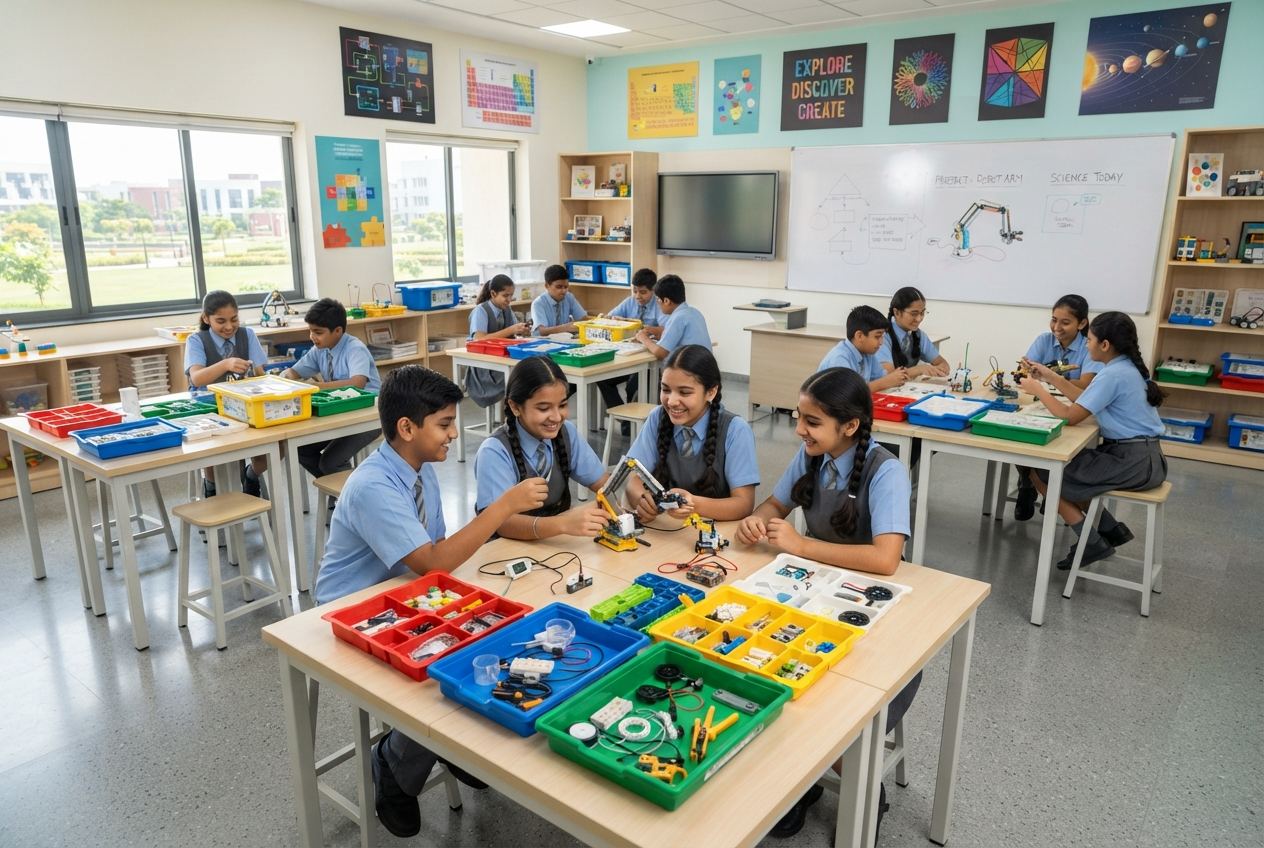
STEM Lab, Robotics Lab or Science Lab?
Schools use these three names loosely, and then order the wrong room. The distinction is not the subject on the door — it is what the room is built around.
| Built around | Used by | Typical output | |
|---|---|---|---|
| Science lab | Fixed apparatus, reagents, sinks and services | Physics, chemistry and biology faculty, to a syllabus | Prescribed practicals, recorded in a journal |
| Robotics lab | Kits, microcontrollers, sensors and a 3D printer | Computer science and the robotics instructor | Robots, automation projects, competition entries |
| STEM / STEAM lab | Open table space, reusable kits, tools and materials across all strands | Several departments on a shared timetable | Projects that are not in any syllabus |
If one spare room has to serve several departments, build the STEM version. A robotics lab is a STEM lab with one strand made dominant — easy to specify, but it tends to be booked by one teacher. Spending part of the same budget on measurement instruments, maths manipulatives and design materials is what makes a physics or maths teacher walk into the room as readily as the computer teacher.
A STEM lab does not replace science practicals. Schools that convert their only science lab into a STEM room lose their prescribed practicals and gain a complaint from the board inspection. Add the STEM room; do not substitute it.
The Five STEAM Strands and What Each Needs
Science
Measurement instruments students can carry to the table — digital multimeters, vernier and micrometer, weighing scales, thermometers, light and sound sensors, a small weather set — so that data collection happens in the project rather than in a separate practical.
Technology
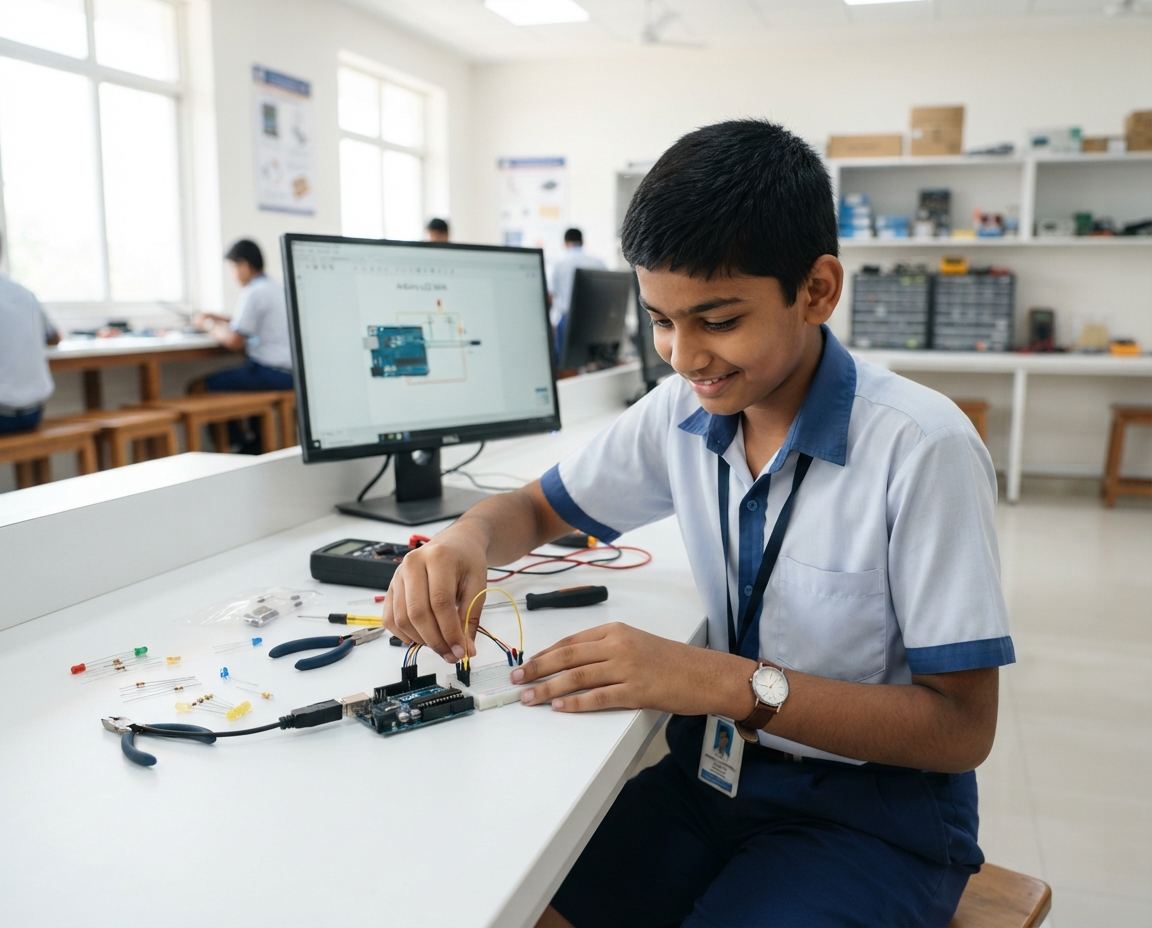
Microcontroller boards and single-board computers, a sensor and actuator set, laptops or desktops for coding and CAD, and reliable power. This is the strand that grows fastest from Class 8 upward.
Engineering
Robotics and construction kits by age band, structural and mechanism sets, hand tools, a rotary multitool, a drill, a cutting mat and clamps — plus the safety kit that has to accompany them.
Arts & Design
The A in STEAM, and the cheapest strand to add: sketching and drafting supplies, card, foam board, craft materials, colour, and a 3D printer with filament so that a designed object becomes a real one within a lesson.
Mathematics
Manipulatives and geometric solids, measuring and drafting instruments, graphing tools and data-logging software — the strand most often dropped from a STEM order, and the one that gets the maths department to use the room.
The Room Itself
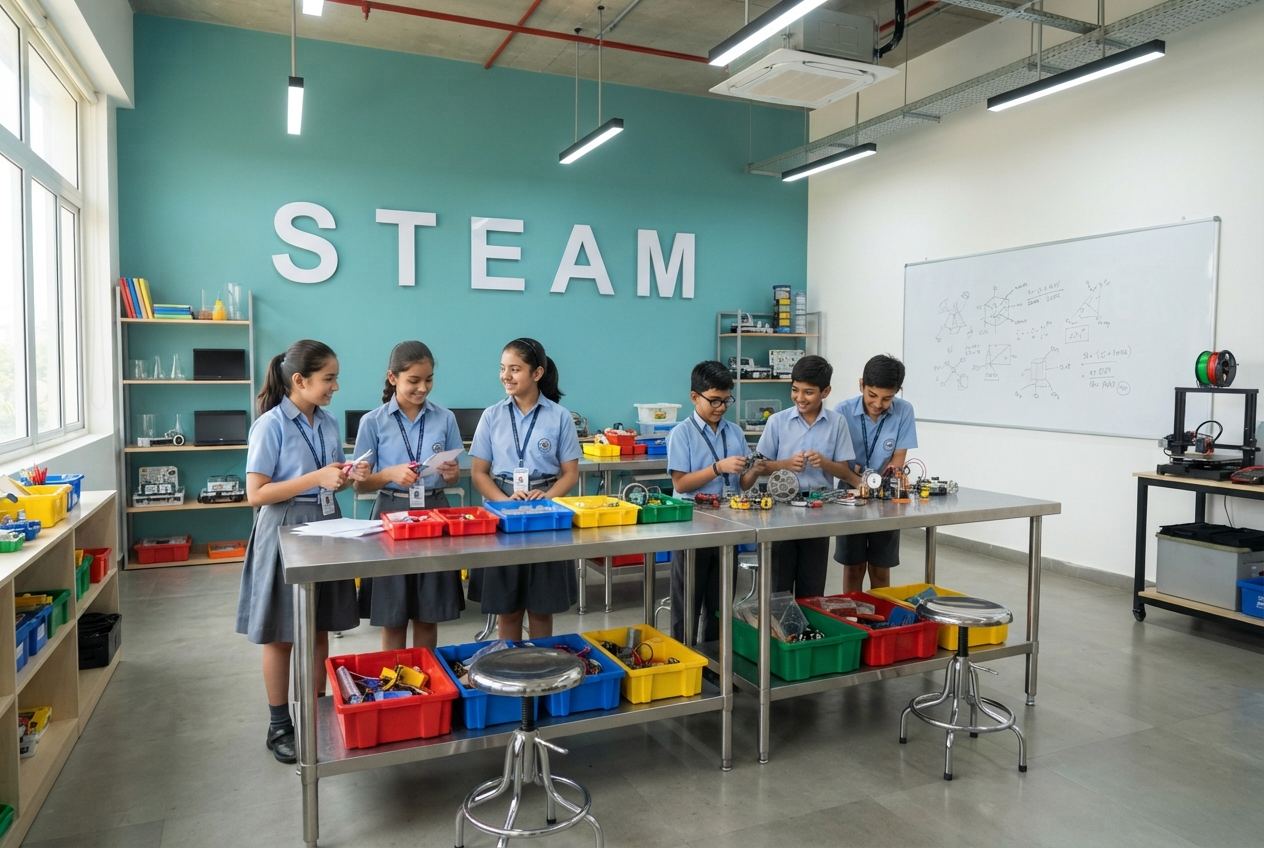
Worktables sized for a kit plus a laptop plus two pairs of hands, stools, labelled component storage, a pegboard tool wall and a project display shelf. See lab furniture for benches and storage.
Zoning a STEM Lab
| Zone | Share of the room | What it needs |
|---|---|---|
| Build area | About half | Island worktables seating four to six, at least 1,200 × 600 mm of clear top per pair of students, two power points per table, strong overhead light. |
| Machine corner | About a quarter | 3D printer on a stable surface away from the door with its UPS; drill, rotary tool and soldering stations on a separate heat-tolerant bench; ventilation. |
| Materials & storage wall | One wall | Labelled drawer units for components, a pegboard tool wall, open shelving for materials, and a lockable cupboard for the expensive items. |
| Discussion & display | The remainder | A clear wall for a display board and projector, space for a class to gather around one build, and a shelf for finished projects. |
Get the build area right first. Everything else can be rearranged in an afternoon; table size and power point positions cannot.
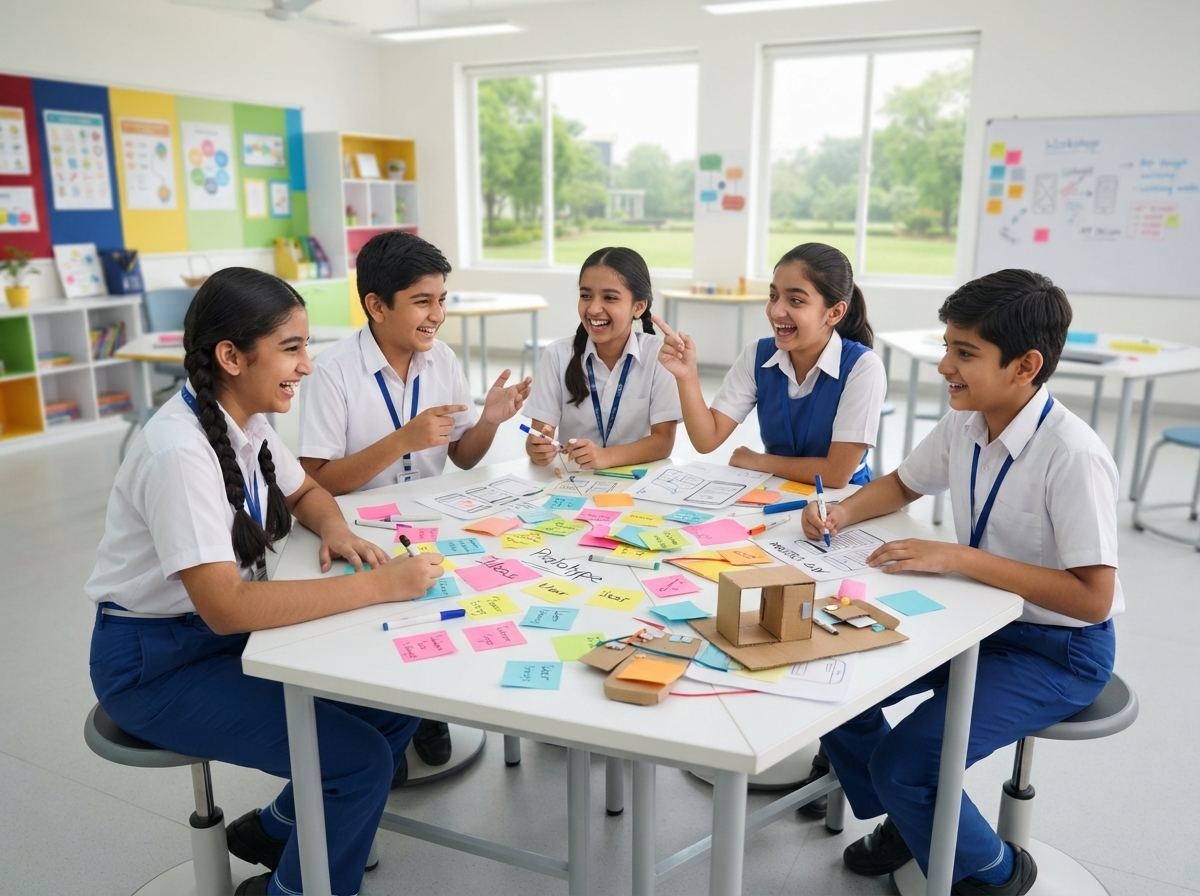
Indicative STEM Lab Costs
| Scale | Covers | Room | Indicative equipment cost |
|---|---|---|---|
| Single batch | About 30 students at a time, Classes 6–8, all five strands at entry level | ~600 sq ft | Rs. 3,00,000 – 5,00,000 |
| Whole school | Two batches, Classes 4–10, 3D printer, full measurement and maths set | 900–1,200 sq ft | Rs. 6,00,000 – 10,00,000 |
| KG–12 | Three age bands, design and arts strand, competition-grade platforms, display area | 1,200–1,500 sq ft | Rs. 11,00,000 – 17,00,000 |
| Furniture, storage & electrical | Worktables, stools, storage, tool wall, display, power points, lighting | — | Rs. 1,50,000 – 4,00,000 |
Indicative figures, not a quotation. They move with brand versus equivalent kits, how many students you are equipping at once, and the state the room starts in. Send your student numbers and room dimensions and we will replace each one with an itemised line.
If your school has a sanctioned Atal Tinkering Lab grant, specify against AIM's published list instead — see our Atal Tinkering Lab equipment list for packages P1–P4 and what the Rs. 20 lakh grant covers.
Related Pages
- Robotics lab for schools — kit types by age band, class sizes and indicative budgets
- Atal Tinkering Lab equipment list — the AIM packages, quantities and grant rules
- Innovation lab for schools — the managed programme with instructors and curriculum
- Robotics lab for colleges — PU, degree and engineering college labs
- Science lab equipment for schools — physics, chemistry and biology apparatus
- Lab furniture — workbenches, stools and storage
Frequently Asked Questions
What is a STEM lab in a school?
A STEM lab is one room equipped so that science, technology, engineering and mathematics can be taught by building rather than by reading. In practice it holds robotics and electronics on one side, prototyping tools and a 3D printer in a machine corner, measurement and maths manipulatives on a shelf, and open table space in the middle for group work. A STEAM lab adds an arts and design strand — sketching, model-making, materials and colour — to the same room.
How is a STEM lab different from a robotics lab?
A robotics lab is a STEM lab with one strand made dominant. If you buy robot kits, microcontrollers, sensors and a printer, you have a robotics lab. A STEM lab spends part of that same budget on measurement instruments, maths manipulatives, materials and design supplies so that a physics or maths teacher can use the room as readily as the computer teacher. Schools with one spare room and several departments wanting it usually want the STEM version.
How is a STEM lab different from a science lab?
A science lab is built around fixed apparatus, reagents, sinks and services, and is used to perform prescribed experiments for a syllabus. A STEM lab is built around open table space, tools and reusable kits, and is used to build things that are not in a syllabus. Most schools need both; a STEM lab does not replace physics, chemistry or biology practicals.
What equipment does a STEM lab need?
Robotics kits by age band; microcontroller boards with a sensor and actuator set; an electronics bench with breadboards, components, multimeters and soldering; a 3D printer with filament plus hand and power tools; measurement instruments and maths manipulatives; art and design materials for the STEAM strand; safety equipment; and the room — worktables, stools, labelled storage, a tool wall and a display area.
How much does a STEM lab cost to set up?
Indicatively, about Rs. 3 to 5 lakh for a single-batch lab of roughly 30 students; Rs. 6 to 10 lakh for a whole-school lab covering two batches with a 3D printer and a full measurement set; and Rs. 11 to 17 lakh for a KG to Class 12 lab with a design and arts strand and competition-grade platforms. Furniture, storage and electrical work add roughly Rs. 1.5 to 4 lakh. These are indicative figures, not a quotation.
How much space does a STEM lab need?
About 600 sq ft for a single batch, and 900 to 1,500 sq ft for a whole-school lab where a build area, a machine corner and a discussion or display area can coexist without students queuing for table space.
Does NEP 2020 require a STEM lab?
NEP 2020 does not mandate a STEM lab by name. It does push experiential, hands-on learning, recommends coding from Class 6, and asks schools to build 21st-century skills, which is why most schools read a STEM or tinkering room as the practical way to deliver it. A sanctioned Atal Tinkering Lab is the government-funded version of the same room.
Can a STEM lab double as an Atal Tinkering Lab?
Yes, and many do. An ATL is the same kind of room funded by a NITI Aayog grant with a mandated equipment list and GeM-only procurement. If your school has an ATL sanction, specify against AIM's published list rather than a general STEM list; if you do not, build the same room at whatever scale you can fund.
Plan a STEM Lab for Your School
Send your student numbers, the classes you want covered and your room dimensions. You get back an itemised equipment list across all five strands, with a zoned bench layout and an electrical plan, within 2–3 working days.