
Science Lab Equipment for Schools
The full apparatus list for a school science laboratory — physics, chemistry and biology equipment with suggested quantities for a 30-student batch, indicative price bands, board-wise requirements, and what changes between a primary, middle and senior secondary lab. CBM IMPEX supplies and installs all of it on one GST invoice.
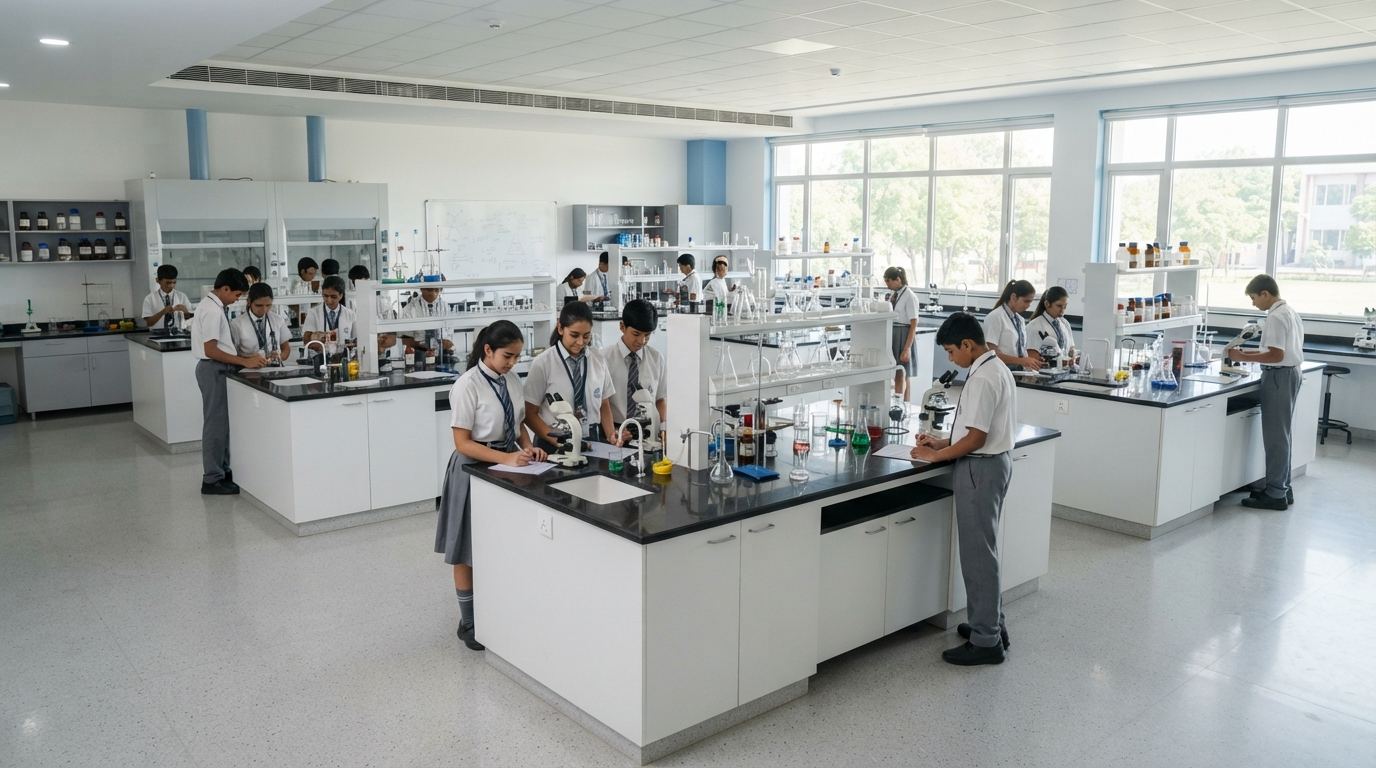
What a School Science Lab Actually Needs
Most schools start this purchase with a supplier catalogue and end up with the wrong depth of stock — one travelling microscope where three are needed, thirty beakers where a hundred will break in a year, and a fume hood specified after the benches are already fixed. The lists on this page are built the other way round: from the practicals your board prescribes, the size of the batch that will use the room at one time, and the storage and safety the room has to carry.
Everything below assumes a standard 30-student batch working in pairs. Where an item is shared and used on rotation — an analytical balance, a still, a centrifuge — the quantity says so. Prices are indicative bands for planning and budget approval, not quotations; the actual rate depends on make, accuracy class and order size, and we quote every line individually.
Physics apparatus
Measurement instruments, mechanics, optics, heat and sound, electricity and magnetism, and Class 12 electronics.
Physics equipment list →Chemistry apparatus
Borosilicate glassware in class sets, heating and measuring apparatus, reagents, a ducted fume hood and PPE.
Chemistry equipment list →Biology equipment
Microscopes and slide sets, anatomical and cell models, specimens, charts and physiology apparatus.
Biology equipment list →Furniture & safety
Workbenches with sinks and reagent racks, chemical storage, eye-wash, fire safety and first aid.
Furniture & safety list →Physics Lab Equipment List
Quantities below are for a 30-student batch working in pairs. Add two to three spares of the high-breakage items — thermometers, meters and stopwatches. For the deeper treatment of a senior secondary physics lab, including wiring and dark-room provision, see the physics lab equipment guide.
| Apparatus | Typical specification | Qty per 30-student batch | Indicative price band* |
|---|---|---|---|
| Vernier caliper | Least count 0.02 mm, stainless steel | 15 | ₹350 – 900 |
| Micrometer screw gauge | Least count 0.01 mm, 0–25 mm | 15 | ₹450 – 1,200 |
| Spherometer | Least count 0.01 mm | 15 | ₹400 – 900 |
| Metre & half-metre scales | Hardwood or steel | 30 | ₹60 – 200 |
| Stop clock / digital stopwatch | 0.1 s or better | 15 | ₹250 – 800 |
| Spring balance set | 0.5 kg, 1 kg, 5 kg | 15 | ₹120 – 400 |
| Physical balance with weight box | Beam type, 100 g sensitivity set | 2 | ₹3,500 – 9,000 |
| Electronic balance | 0.01 g, 500 g capacity | 1 – 2 | ₹6,000 – 18,000 |
| Travelling microscope | Vernier 0.01 mm, horizontal & vertical travel | 2 – 4 | ₹12,000 – 28,000 |
| Optical bench | 1.5 m, four uprights, pin and needle sets | 8 – 10 | ₹4,500 – 12,000 |
| Lens and mirror set | Convex & concave, assorted focal lengths | 15 | ₹600 – 1,800 |
| Glass prism | Equilateral, 38 mm face | 15 | ₹180 – 500 |
| Sonometer with weights | Steel wire, movable bridges | 4 – 6 | ₹2,500 – 6,000 |
| Resonance tube apparatus | With reservoir and stand | 4 – 6 | ₹2,800 – 7,000 |
| Tuning fork set | 256–512 Hz, eight forks | 4 sets | ₹900 – 2,500 |
| Calorimeter with stirrer | Copper, with insulating jacket | 10 | ₹350 – 900 |
| Metre bridge with jockey | With standard resistance coils | 10 | ₹1,200 – 3,000 |
| Potentiometer | 10-wire, with jockey | 8 – 10 | ₹2,500 – 6,500 |
| Table galvanometer | 30-0-30 µA, with shunt accessories | 10 | ₹900 – 2,400 |
| DC ammeter & voltmeter | Syllabus ranges 0–3 A, 0–3 V, 0–15 V | 15 each | ₹400 – 1,200 |
| Resistance box | Plug type, 1–100 Ω and 1–5000 Ω | 10 – 15 | ₹700 – 2,000 |
| Rheostat | Sliding, 50 Ω / 100 Ω | 10 – 15 | ₹600 – 1,800 |
| Regulated DC supply / eliminator | 2–12 V, current limited | 10 – 15 | ₹700 – 2,200 |
| Digital multimeter | Auto-ranging, CAT II | 5 – 10 | ₹500 – 1,800 |
| Diode & Zener characteristics board | With built-in meters or terminals | 5 – 8 | ₹1,500 – 4,000 |
| Logic gate / transistor kit | For Class 12 electronics practicals | 5 | ₹1,800 – 5,000 |
| Connecting wires, keys, clips, sandpaper | Consumable class stock | 1 lot | ₹3,000 – 8,000 |
* Indicative per-unit bands for planning only, exclusive of taxes and freight; actual rates depend on make, accuracy class and order quantity.
Chemistry Lab Equipment and Glassware List
Chemistry is the glassware-heavy subject and the one where safety equipment is not optional. Stock glassware above one set per pair — breakage of ten to fifteen per cent a year is normal. Full detail, including reagent storage discipline, is on the chemistry lab equipment page.
| Item | Typical specification | Qty per 30-student batch | Indicative price band* |
|---|---|---|---|
| Beakers (borosilicate) | 100 ml, 250 ml, 500 ml | 30 of each | ₹60 – 220 |
| Conical flasks | 100 ml and 250 ml | 30 of each | ₹90 – 260 |
| Round-bottom / flat-bottom flasks | 250 ml | 15 | ₹120 – 350 |
| Measuring cylinders | 10 ml, 50 ml, 100 ml | 15 of each | ₹80 – 300 |
| Burettes with stand and clamp | 50 ml, glass stopcock | 15 | ₹300 – 850 (burette) |
| Pipettes | 10 ml and 20 ml bulb pipettes | 15 of each | ₹60 – 200 |
| Volumetric flasks | 100 ml and 250 ml | 15 | ₹150 – 450 |
| Test tubes | Borosilicate 15 × 150 mm | 150 – 200 | ₹15 – 40 |
| Test tube stands, holders, brushes | Wooden or PP stands | 15 of each | ₹80 – 250 |
| Funnels, watch glasses, china dishes | 75 mm funnel; 100 mm watch glass | 15 of each | ₹50 – 300 |
| Crucibles with lid and tongs | Silica or porcelain | 15 | ₹90 – 320 |
| Bunsen burners or spirit lamps | LPG burner where gas is piped | 15 | ₹250 – 900 |
| Tripod stands with wire gauze | MS tripod, ceramic-centre gauze | 15 | ₹180 – 550 |
| Retort stands with clamps and rings | Cast-iron base | 15 | ₹350 – 900 |
| Laboratory thermometers | −10 to 110 °C, 1 °C divisions | 15 | ₹120 – 350 |
| Hot plate or water bath | Thermostatic | 2 | ₹2,500 – 9,000 |
| Desiccator | 150–200 mm with plate | 1 | ₹2,500 – 7,000 |
| Distillation / all-glass water still | 2–4 litres per hour | 1 | ₹8,000 – 25,000 |
| Digital pH meter | 0–14 pH, with buffer sachets | 1 – 2 | ₹3,500 – 12,000 |
| Analytical electronic balance | 0.001 g, with draught shield | 1 | ₹18,000 – 45,000 |
| Ducted fume hood | 4 ft, acid-resistant lining, blower | 1 | ₹65,000 – 1,60,000 |
| Reagent and indicator stock | Qualitative analysis salts, volumetric solutions, indicators | 1 lot | ₹25,000 – 60,000 |
| Student PPE | Splash goggles, apron, nitrile gloves | 30 sets | ₹120 – 450 per item |
* Indicative per-unit bands for planning only. Reagent stock varies with the qualitative analysis scheme your board prescribes.
Biology Lab Equipment List
Microscopes dominate the biology budget, so buy the optics first and the decoration later. Fifteen student microscopes let a 30-student batch work in pairs without queueing; a single good binocular instrument at the teacher station handles demonstration. See the biology lab equipment page for slide sets and specimen detail.
| Item | Typical specification | Qty per 30-student batch | Indicative price band* |
|---|---|---|---|
| Compound student microscope | Monocular, 100×–1000×, LED illumination | 15 | ₹4,500 – 14,000 |
| Binocular microscope (teacher station) | Research grade, 1000× | 1 – 2 | ₹18,000 – 55,000 |
| Prepared slide sets | Botany and zoology, 50–100 slides per set | 4 – 6 sets | ₹1,500 – 6,000 |
| Blank slides and cover slips | 72-slide and 100-cover-slip boxes | Class stock | ₹300 – 900 per box |
| Hand lenses and dissecting microscopes | 10× lens; 20× stereo | 15 | ₹300 – 2,500 |
| Human torso model | Life size, removable organs | 1 | ₹6,000 – 18,000 |
| Human skeleton on stand | Full size, articulated | 1 | ₹8,000 – 25,000 |
| Organ model set | Heart, brain, eye, ear, kidney | 1 set | ₹5,000 – 15,000 |
| DNA and cell models | Double helix, plant and animal cell | 1 set | ₹2,500 – 8,000 |
| Botanical specimens and herbarium sheets | Preserved specimens, mounting sheets | 1 set | ₹2,000 – 7,000 |
| Laminated biology charts | 30–50 charts covering the syllabus | 1 set | ₹1,500 – 5,000 |
| Incubator or hot air oven | 50–65 litre, thermostatic | 1 | ₹12,000 – 35,000 |
| Centrifuge | 8-tube, 3,000 rpm | 1 | ₹6,000 – 18,000 |
| Physiology apparatus | Potometer, respirometer, osmoscope, ganong’s light screen | 2 – 4 each | ₹800 – 3,000 |
| Chromatography and staining kit | Paper chromatography set, stains and reagents | 1 | ₹1,200 – 4,000 |
| Aquarium or vivarium | Demonstration tank with aerator | 1 | ₹3,000 – 12,000 |
* Indicative per-unit bands for planning only. Microscope pricing moves most with optics quality — achromatic objectives and a good condenser are worth the difference.
Lab Furniture and Safety Equipment
Apparatus is only half the purchase. The benches decide how many students can work at once, the storage decides whether chemicals pass inspection, and the safety kit decides whether the lab may be used at all. Bench and storage options are covered in detail on the science lab furniture page.
| Item | Typical specification | Qty per lab | Indicative price band* |
|---|---|---|---|
| Student workbench | Granite or epoxy-resin top, reagent rack, sink, under-bench storage; seats 8 | 4 per 32-student lab | ₹28,000 – 75,000 each |
| Demonstration table | Teacher bench with sink, gas and power points | 1 | ₹25,000 – 60,000 |
| Laboratory stools | Height 600–750 mm, MS frame | 32 | ₹900 – 2,500 |
| Chemical storage cupboard | Lockable, vented, segregated shelving | 2 | ₹15,000 – 45,000 |
| Glassware and apparatus cabinet | Glazed doors, adjustable shelves | 2 – 3 | ₹12,000 – 35,000 |
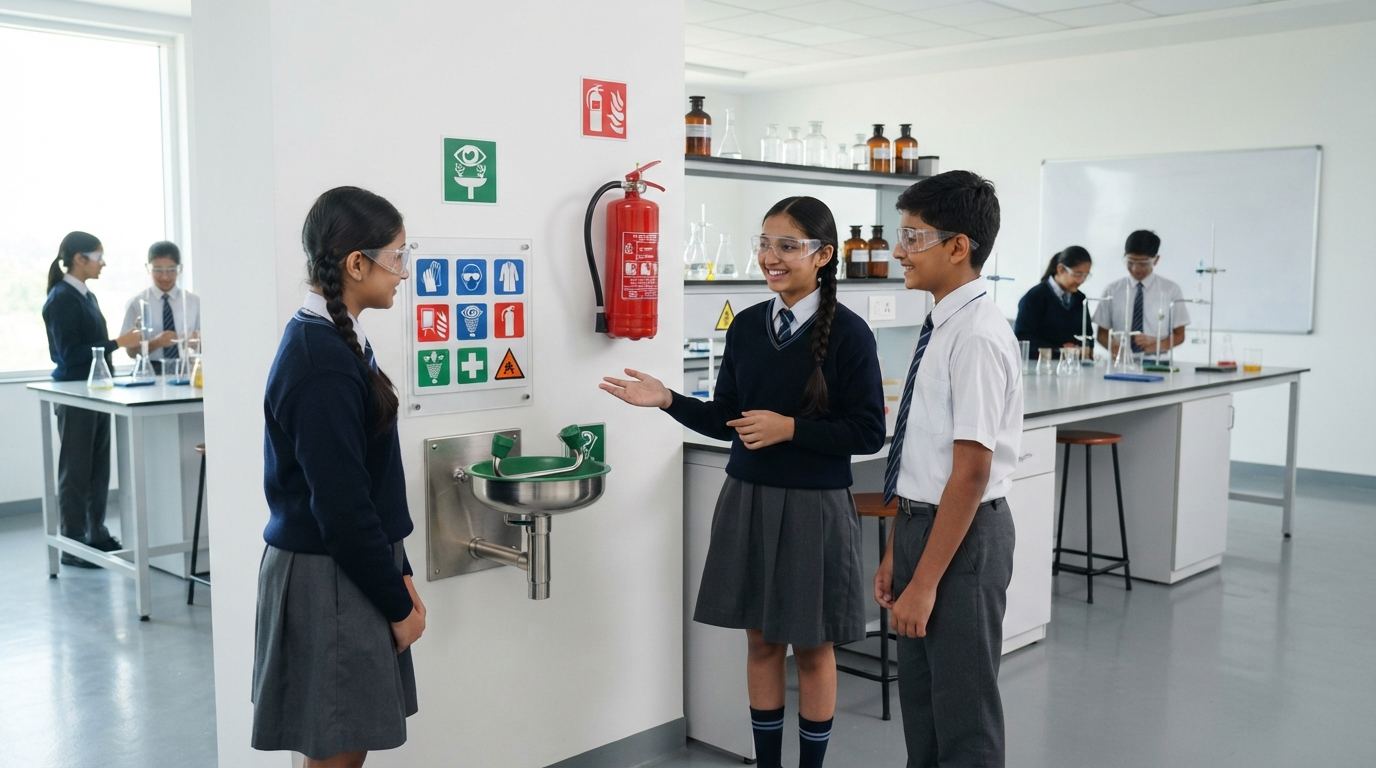
| Eye-wash station | Plumbed or gravity-fed, near chemistry benches | 1 | ₹3,500 – 15,000 |
| Fire safety set | CO₂ or DCP extinguisher, sand bucket, fire blanket, signage | 1 set per lab | ₹4,000 – 12,000 |
| First-aid box (stocked) | Wall mounted, with burn and eye-injury items | 1 | ₹1,200 – 4,000 |
* Indicative bands for planning only. Worktop material — granite, epoxy resin or phenolic — is the biggest single variable in bench cost.
Primary, Middle and Senior Labs: What Changes
The same section of a school rarely needs the same lab. What changes between stages is not only the quantity of equipment but the kind: primary science is handled equipment, middle school is demonstration-led, and senior secondary is examined practical work with its own apparatus per student.
| School stage | Lab format | Core equipment | Indicative budget* |
|---|---|---|---|
| Primary (Classes 1–5) | No separate laboratory is required. A science activity corner or shared activity room. | Magnifiers, magnet sets, simple balances, measuring jars, model kits, germination trays, weather charts, junior microscope | ₹40,000 – 1.5 lakh |
| Middle (Classes 6–8) | A science room used mainly for teacher demonstration plus small-group work. | Demonstration table, basic glassware, magnets and circuits kits, junior microscopes, model sets, charts | ₹1.5 – 4 lakh |
| Secondary (Classes 9–10) | One composite science laboratory — the CBSE norm up to Class 10 (about 600 sq ft). | Full student benches with sinks, class-set glassware, measurement instruments, microscopes, chemical storage, safety package | ₹4.5 – 9 lakh |
| Senior secondary (Classes 11–12) | Separate physics, chemistry and biology laboratories, one per subject offered. | Subject-specific instrument sets in class quantities, fume hood, analytical balance, optical benches, research microscope | ₹15 – 30 lakh for all three |
* Indicative totals including furniture, apparatus, chemicals, safety equipment and installation; civil work excluded.
Buying for Classes 1–5? The equipment, room and safety rules are different enough to warrant their own guide — see science lab equipment for primary and elementary schools.
Board-Wise Science Lab Requirements
Lab infrastructure is an affiliation requirement, not a nice-to-have. The table summarises what each board expects; we specify every lab so the room size, furniture and equipment list stand up to inspection.
| Board | Classes | Lab requirement | Typical size |
|---|---|---|---|
| CBSE | Up to Class 10 (Secondary) | One composite science laboratory covering physics, chemistry and biology, per the Affiliation Bye-laws | ~9 m × 6 m (about 600 sq ft) |
| CBSE | Classes 11–12 (Science stream) | Separate, fully equipped physics, chemistry and biology labs; a mathematics lab is also expected | ~9 m × 6 m each |
| ICSE (CISCE) | Up to Class 10 | Adequately equipped science laboratory facilities for the prescribed science syllabus | ~55–60 sq m recommended |
| ISC (CISCE) | Classes 11–12 | A separate, well-equipped laboratory for each science subject offered, with individual workstations for practical exams | Per subject offered |
| Karnataka State Board | Classes 8–10 | Science room or laboratory with the prescribed apparatus under school recognition norms | ~40–60 sq m |
| Karnataka PU (DPUE) | Classes 11–12 (PU Science) | Separate physics, chemistry and biology labs for PCMB / PCMC combinations | Per subject |
Norms are summarised for planning; exact requirements follow the current affiliation bye-laws and inspection checklists of each board.
Indicative Science Lab Budgets
These bands are for planning and management approval. All are indicative, include furniture, equipment, chemicals, safety gear and installation, and exclude civil work and flooring.
| School profile | Recommended setup | Indicative budget* |
|---|---|---|
| Middle school (up to Class 8, single section) | Compact composite lab | ₹4.5 – 6.5 lakh |
| Secondary school (up to Class 10) | Full composite lab to the CBSE ~600 sq ft norm | ₹6 – 9 lakh |
| New senior secondary science stream (single section) | Separate physics, chemistry & biology labs | ₹15 – 22 lakh |
| Established senior secondary, multiple sections | Three labs with deeper equipment sets and spares | ₹22 – 30 lakh |
| Premium or international campus | Three labs, maths lab and digital integration (panels, data loggers) | ₹30 – 60 lakh |
* Indicative ranges for typical 30–40 student batches. Room dimensions, worktop material and equipment depth move the number — request an itemised quotation.
Supplied, Installed and Restocked by One Vendor
Itemised, board-mapped lists
We build the quotation line by line from the practical syllabus of your board and the classes you teach, so nothing on the inspection checklist is missing and nothing unused is bought.
Layout before purchase
A measured survey and a scaled bench layout come first — sink and power positions, aisle widths, fume hood location and storage walls — because equipment bought before the layout usually does not fit the room.
Furniture, apparatus and chemicals together
Benches, instruments, glassware, reagents and the safety package on one order and one GST invoice, delivered on one schedule instead of six.
Installation and commissioning
Benches installed and levelled, service points tested, chemical storage segregated and labelled, safety equipment mounted, stock registers opened and teachers oriented before handover.
Annual replenishment
Reagents, indicators, glassware breakage and consumables restocked each year, with equipment servicing and a pre-inspection audit for schools on an AMC.
One campus supplier
Schools that build labs with us also source school furniture, smart classrooms, computer labs and robotics labs on the same account.
Frequently Asked Questions
What equipment is needed in a school science lab?
A school science lab needs five groups of equipment. First, measurement and physics apparatus: vernier calipers, screw gauges, spherometers, metre scales, stop clocks, balances, optical benches, metre bridges, potentiometers, galvanometers, ammeters, voltmeters, resistance boxes and regulated DC supplies. Second, chemistry glassware and apparatus: beakers, conical flasks, burettes, pipettes, volumetric flasks, test tubes, burners, tripods, retort stands, thermometers and a ducted fume hood. Third, biology equipment: compound microscopes, prepared slide sets, human torso and skeleton models, organ and cell models, specimens and charts. Fourth, lab furniture: student workbenches with sinks and reagent racks, a demonstration table, stools and lockable chemical storage. Fifth, the safety package: eye-wash, fire extinguisher, sand bucket, fire blanket, first-aid box and student PPE.
How many sets of apparatus does a 30-student batch need?
Plan for students working in pairs, so 15 working sets of the common instruments, plus two or three spares of the items that break or drift most: thermometers, burettes, stopwatches and meters. Shared, expensive items such as a travelling microscope, analytical balance, distillation still or centrifuge are supplied in ones and twos and used on rotation. Glassware such as test tubes and beakers is stocked well above one-per-student because breakage is routine.
How much does science lab equipment for a school cost?
As indicative planning bands: a primary science activity corner is about Rs. 40,000 to 1.5 lakh; a middle school science room Rs. 1.5 to 4 lakh; a composite secondary lab to the CBSE 600 sq ft norm Rs. 4.5 to 9 lakh; and separate physics, chemistry and biology labs for Classes 11-12 Rs. 15 to 30 lakh in total. Those figures include furniture, apparatus, glassware, chemicals, safety equipment and installation, and exclude civil work. Equipment depth and worktop material move the number most.
What are the CBSE science lab requirements for affiliation?
Under the CBSE Affiliation Bye-laws, a school affiliated up to secondary level (Class 10) needs at least one composite science laboratory of roughly 9 m by 6 m, about 600 sq ft. A school running the science stream at senior secondary level (Classes 11-12) needs separate, fully equipped physics, chemistry and biology laboratories, and a mathematics laboratory is also expected. The apparatus held must support the prescribed practical syllabus for every class taught.
What science lab equipment do primary and elementary schools need?
Primary schools are not required to build a laboratory. What works at that stage is a science activity corner or a shared activity room stocked with magnifiers, magnet sets, simple balances and measuring jars, circuit and pulley kits, germination trays, model sets and a junior microscope for demonstration. The emphasis is on durable, low-hazard equipment that children can handle themselves, with no open flames and no concentrated chemicals.
Do you supply chemicals, glassware and consumables through the year?
Yes. Beyond the initial stocking we run annual replenishment covering reagents and indicators, glassware breakage replacement, and consumables such as filter paper, litmus and cover slips. Schools on an annual maintenance contract also get equipment servicing and a pre-inspection audit before board visits.
Can we buy only equipment, without the furniture or installation?
Yes. Schools that already have benches and storage often order only the apparatus, glassware and chemicals against an itemised list, and we deliver against a single GST invoice. Equally, schools building a new block can hand us the room and take back a commissioned lab. Both are quoted line by line so the management committee can see exactly what is being bought.
Which boards and school types do you supply?
CBSE, ICSE and ISC, Karnataka State Board and PU, IB and Cambridge schools, plus government and aided schools buying through departmental tenders. Equipment lists are built from the practical syllabus of the board you follow rather than from a generic catalogue, and quotations carry GST invoicing and the documentation a trust or management committee needs for approval.
Equipment Lists by Subject and Lab Type
- Equipment for a physics lab — apparatus list, quantities and wiring
- Chemistry lab equipment list — glassware, reagents and fume hood
- Biology lab equipment list — microscopes, models and specimens
- Composite science lab equipment — one lab for Classes 6–10
- Science lab equipment for primary schools — Classes 1–5
- Science lab furniture and the detailed school lab furniture page
- Robotics lab for schools · computer lab setup · smart classrooms
Get an Itemised Science Lab Equipment List
Send your board, the classes you teach and your room dimensions. We will return a line-by-line equipment list with quantities and prices, and a bench layout for the room, within 2–3 working days.