
Science Lab Furniture for Schools
Granite and epoxy-top workbenches with reagent racks and sinks, demonstration tables, lab stools, chemical storage cupboards, and glassware cabinets — designed to your room, fabricated to school-duty standards, and installed by CBM IMPEX across Bangalore and Karnataka.
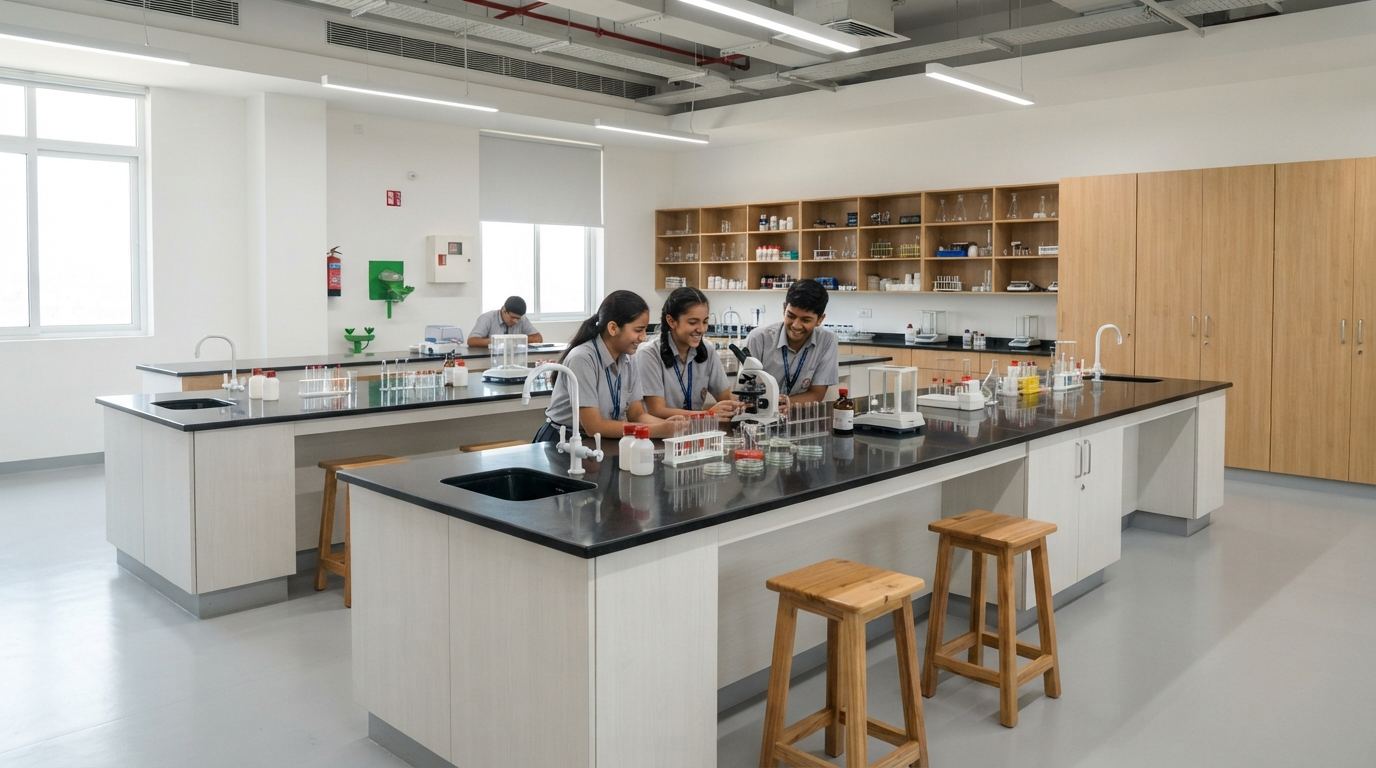
Furniture Is Half the Lab — and Most of Its Lifespan
Instruments get replaced; benches stay for twenty years. Lab furniture typically absorbs 35-45% of a science lab budget, and it is the part that decides whether the room survives two decades of acid spills, water, and 30 students a period. This page summarises what we build for science labs specifically — for the complete range, specifications, and materials detail, see our main school lab furniture page, part of the full school furniture catalogue.
Everything is fabricated to your room dimensions — steel or hardwood underframes, chemical-resistant worktops, and marine-ply or powder-coated storage — then delivered and installed by our own crew.
Workbenches & Tables
Student Workbenches
4-seater and 6-seater island or row benches with two-tier reagent racks, sinks with acid-resistant PP waste lines, and under-bench cupboards. Standard height 850-900 mm for standing/stool work.
Wall / Side Benches
Continuous wall-mounted benches for instruments, balances, and equipment staging — the cheapest way to add working surface to a small lab without eating floor space.
Demonstration Tables
Raised teacher's bench with its own sink, gas point, and power sockets, sized so a full class can see — doubles as the examiner's station in board practicals.
Anti-Vibration Balance Table
A rigid, isolated table (stone slab on independent frame) for analytical balances and microscopy where bench vibration would blur readings.
Worktop options: polished granite (the Indian school standard — hard, acid-tolerant, economical), epoxy resin (best chemical resistance, seamless, premium price), and phenolic/compact laminate (light, good for physics and biology benches where acid exposure is low). We recommend granite for chemistry and composite labs, phenolic for physics, and either for biology.
Storage: Where Inspections Are Won
Chemical Storage Cupboards
Lockable steel or marine-ply cupboards with segregated, labelled shelving for acids, bases, salts, and a separate ventilated flammables cabinet — laid out to the storage map we hand over at commissioning.
Glassware Cabinets
Glass-front cabinets that keep burettes, flasks, and beakers dust-free, visible for stock checks, and within reach at practical time.
Apparatus & Instrument Cupboards
Deep-shelf cupboards for physics kits and boxed instruments, with foam-lined drawers for vernier calipers, screw gauges, and other precision items.
Specimen & Display Cabinets
Glass-front museum cabinets for biology specimens and models — storage that doubles as the lab's display and scores visibly with inspectors and visiting parents.
Stools, Sinks & Fittings
- Lab stools — steel-frame stools with wooden or PU tops, fixed height (450-600 mm, matched to bench height) or adjustable; stackable options for multi-use rooms.
- Sinks and taps — PP or ceramic oval/rectangular lab sinks, swan-neck taps, and acid-resistant bottle traps; one sink per 4-6 students in chemistry, one per bench in biology.
- Reagent racks and pegboards — two-tier powder-coated racks down the bench spine, and wall pegboards for drying glassware above the sinks.
- Services trunking — bench-spine trunking that carries power, and optionally gas, to each working position above spill height.
Typical bench dimensions we quote against: student benches 1200-1800 mm per pair of students, 750 mm deep; wall benches 600 mm deep; demonstration tables 2400 × 750 mm at 900 mm height. Every project starts from your room drawing, not a standard catalogue size.
Fume Hoods & Extraction
A fume hood is usually the single most expensive item in a chemistry fit-out, and the one most often left out of a first budget. Any school running senior-secondary practicals that involve concentrated acids, bromine, hydrogen sulphide or heating volatile organics needs one working hood, not a cupboard with a fan in it.
| Type | Typical Size | Suited To | Indicative Cost* |
|---|---|---|---|
| Bench-top ducted hood | 900–1200 mm wide | One-hood school chemistry lab; sits on an existing wall bench | ₹85,000–1,50,000 |
| Floor-mounted walk-in hood | 1200–1800 mm wide | Tall apparatus, distillation columns, PU college labs | ₹1,60,000–3,20,000 |
| Ductless filtered hood | 900–1200 mm wide | Rooms where an external duct run is impossible; needs cartridge changes | ₹1,10,000–2,10,000 |
What drives the real cost is rarely the hood itself but the duct run: an external wall within a few metres is inexpensive, a route up through two floors to a terrace discharge is not. Specify the liner (epoxy-coated steel for school use, PP where hydrofluoric acid is handled), a face velocity of roughly 0.5 m/s at the sash opening, and a discharge point clear of windows and air intakes. The extract fan belongs at the discharge end of the duct, so the run stays under negative pressure along its length.
*Indicative only, exclusive of taxes, duct work and civil work. Figures are confirmed against your room drawing and a current quotation.
Indicative Laboratory Furniture Budgets
| Scope | Typical Contents | Indicative Budget* |
|---|---|---|
| Furniture refresh (existing lab) | Re-topping benches, new stools, one storage wall | ₹1.5 – 3 lakh |
| Single lab, full furniture | Student benches with sinks and racks, demo table, stools, storage cupboards, cabinets, installation | ₹2.5 – 5 lakh |
| Three-lab suite, full furniture | Complete furniture for physics, chemistry, and biology labs including chemical and specimen storage | ₹7 – 12 lakh |
* Indicative ranges; granite vs epoxy tops and bench count move the number. Combine furniture with equipment in one turnkey science lab quote for the best pricing.
Frequently Asked Questions
Which worktop is best for a school science lab — granite, epoxy, or phenolic?
Granite is the Indian school standard: hard, acid-tolerant, easy to source, and economical — our default for chemistry and composite labs. Epoxy resin offers the best chemical resistance and a seamless surface at a premium price, worth it for heavy-use senior secondary chemistry labs. Phenolic/compact laminate is lighter and cheaper, ideal for physics and biology benches where acid exposure is minimal.
What does science lab furniture cost for a school?
Indicatively: Rs. 2.5-5 lakh fully furnishes a single lab (benches with sinks and reagent racks, demonstration table, stools, and storage), Rs. 7-12 lakh covers a three-lab suite, and a furniture refresh of an existing lab runs Rs. 1.5-3 lakh. Bench count, worktop material, and storage depth drive the range — quotations are itemised against your room drawing.
Do you make lab furniture to custom room sizes?
Yes — everything is fabricated to your room. We measure on site (or work from your building plan), produce a layout drawing with bench positions and service points, and fabricate benches, storage, and the demonstration table to those dimensions. Odd-shaped rooms, columns, and low windows are handled at the drawing stage, not discovered at installation.
Can you supply lab furniture without the equipment?
Yes. Many schools order furniture-only — new benches and storage for a lab whose instruments are fine, or furniture for a new building ahead of an equipment decision. See the detailed specifications on our school lab furniture page, or ask for a furniture-only quotation. Equally, furniture and equipment together in one turnkey contract usually prices better than two separate purchases.
How long does lab furniture fabrication and installation take?
Fabrication typically takes 2-3 weeks from drawing approval, and on-site installation 3-6 working days per lab including plumbing connections to your stub points and levelling. Most schools slot installation into a vacation window; we sequence fabrication so the site work fits the break.
Get a Lab Furniture Quotation
Send your room dimensions and a photo of the space — we will reply with a layout and an itemised furniture quotation within 2-3 working days.