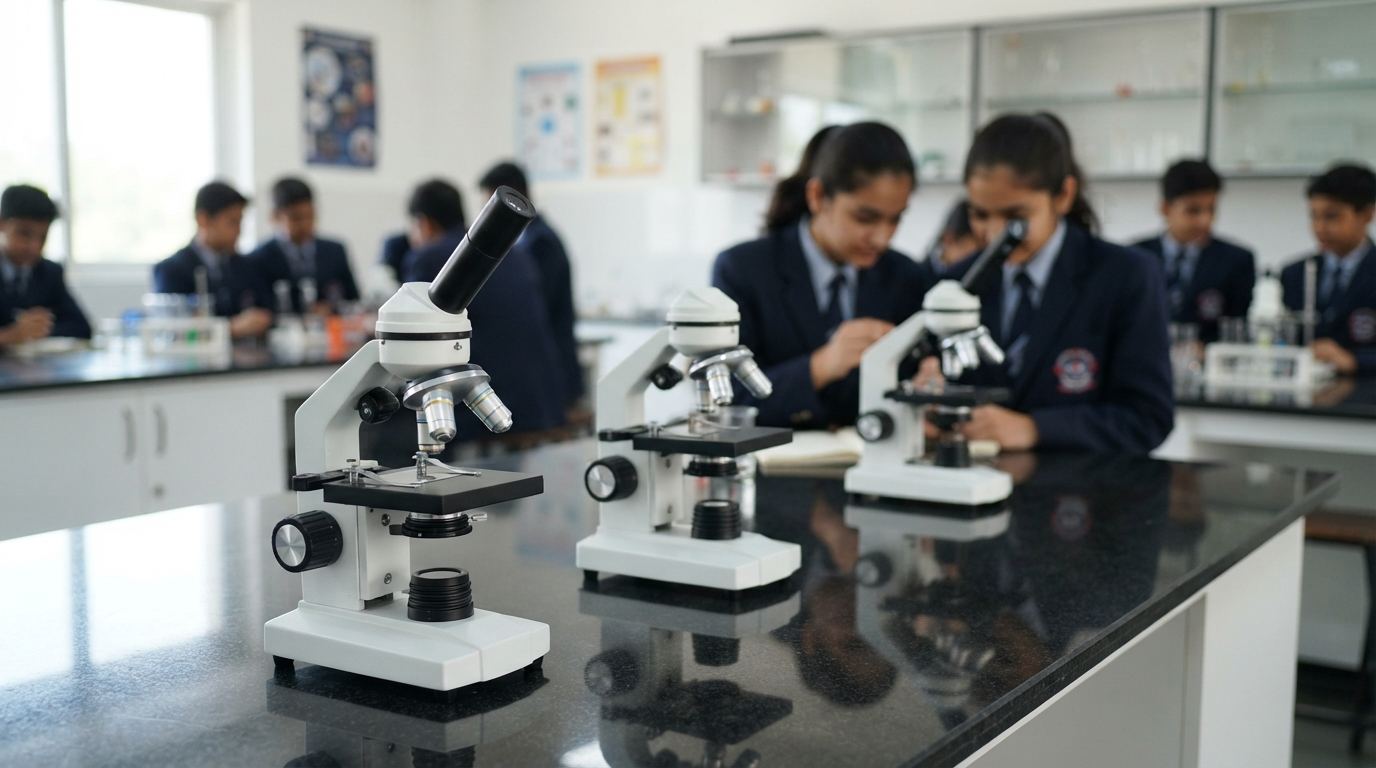
Biology Lab Equipment for Schools
Complete school biology labs — student and binocular microscopes, prepared slide sets, human torso and skeleton models, botany specimens, charts and herbarium material, with dissection alternatives that follow current CBSE norms. Supplied, installed, and teacher-trained.
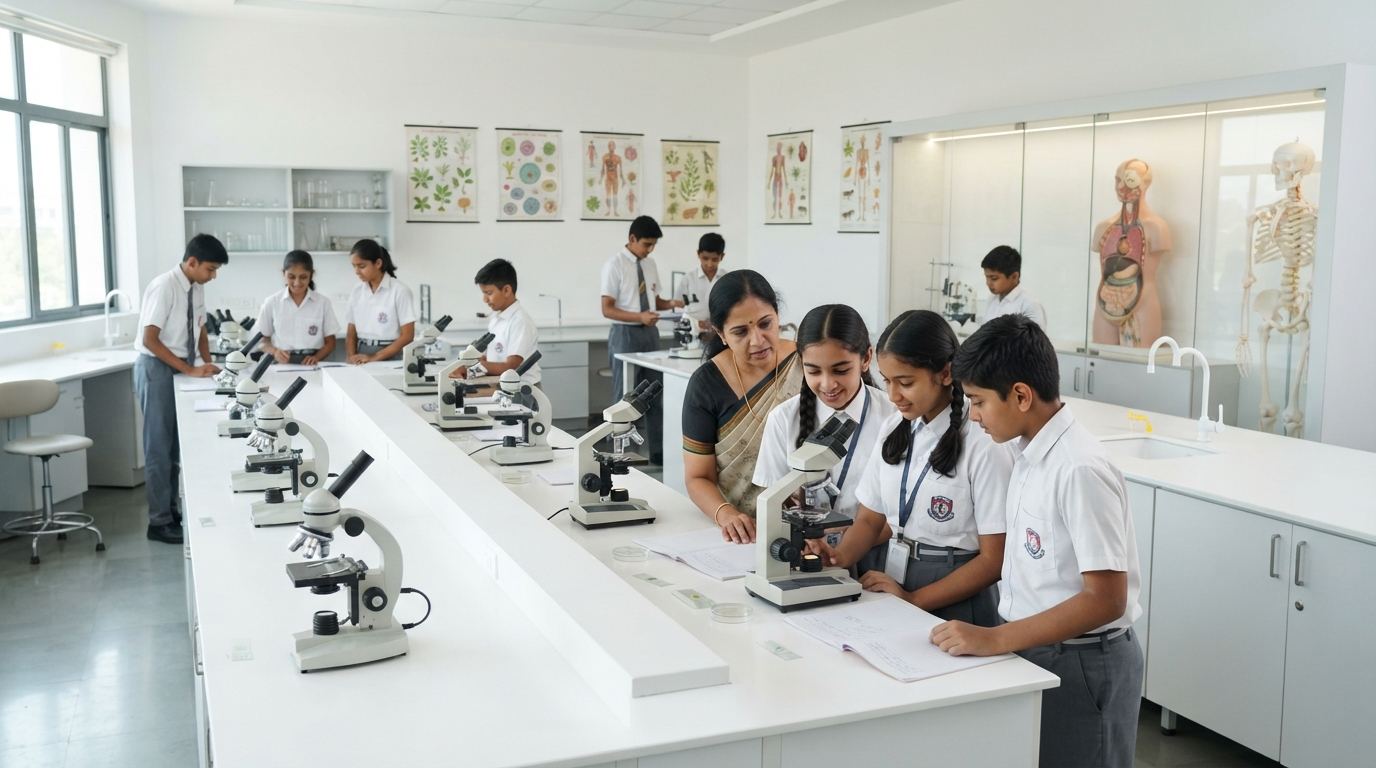
Microscopes: The Heart of the Biology Lab
Everything else in a biology lab is support equipment; the microscopes decide whether practicals actually work. We supply and service the full range a school needs, with dust covers, spare bulbs/LED modules, and immersion oil included:
Student Compound Microscopes
Monocular, 100x-600x with 4x/10x/40x objectives, LED illumination, and rugged focusing built for daily class use. The workhorse — one per pair of students (15 for a 30-student batch).
Binocular Microscopes
1000x with oil-immersion 100x objective and mechanical stage, for senior secondary histology and the teacher's demonstration station. 2-4 per lab.
Dissecting / Stereo Microscopes
Low-magnification (20x-40x) stereo heads for flower dissection, external morphology, and specimen study — the instruments that replaced much of what animal dissection used to teach.
Digital & Projection Options
Camera-equipped microscopes that project the slide onto your classroom's interactive panel — every student sees the same field the teacher describes. Pairs perfectly with a smart classroom setup.
Biology Lab Equipment List
Suggested stocking for a 30-student batch; every quotation is itemised to your board's practical syllabus.
| Category | Items | Suggested Qty |
|---|---|---|
| Microscopes | Student compound, binocular, dissecting/stereo | 15 + 2-4 + 4-6 |
| Prepared slide sets | Botany (root/stem/leaf T.S., mitosis in onion root tip), zoology (blood smear, epithelium, nerve cell), microbiology (bacteria, protozoa) | 2-3 boxed sets of 50-100 |
| Slide-making kit | Plain slides, cavity slides, coverslips, watch glasses, needles, brushes, forceps, scalpels, blotting paper | Class stock |
| Stains & reagents | Safranin, methylene blue, iodine solution, glycerine, acetocarmine; Benedict's, Fehling's, Biuret for food tests | Annual stock |
| Human anatomy models | Half-size human torso with removable organs, articulated skeleton, heart, brain, eye, ear, kidney/nephron, DNA double helix | 1 each |
| Botany models & specimens | Flower models (hibiscus, pea), root/stem/leaf sections, preserved plant specimens, seed germination sets | 1-2 each |
| Zoology specimens | Museum-mounted preserved specimens (earthworm, honeybee, starfish, fish, frog skeleton) in acrylic/formalin jars | 10-20 jars |
| Physiology apparatus | Potato osmometer setup, Ganong's potometer, bell jar photosynthesis setup, haemocytometer (senior) | 4-6 sets |
| Charts | Cell structure, photosynthesis, human systems, genetics, ecology — laminated wall sets | 25-40 charts |
| Herbarium & field kit | Herbarium sheets, plant press, pooter/collection kit, hand lenses | Class stock |
| General apparatus | Beakers, test tubes, petri dishes, droppers, spirit lamps, wash bottles, electronic balance | Class stock |
Dissection Alternatives: What CBSE Norms Mean for Your Lab
Animal dissection has been phased out of Indian school syllabi — CBSE removed animal dissections from school practicals years ago, in line with UGC and animal-welfare guidelines, and inspectors now expect to see the alternatives, not the dissection trays. A modern biology lab covers the same learning outcomes with:
- High-quality anatomical models — removable-organ torsos, dissectible heart and brain models, and system-by-system charts that let students locate and relate organs repeatedly, which a one-time dissection never allowed.
- Permanent prepared slides — professionally sectioned and stained tissue slides give a clearer view of histology than a school-made specimen ever did.
- Preserved museum specimens — sealed acrylic-mounted specimens for external morphology study, handled without formalin exposure.
- Virtual dissection software — interactive 3D dissection on the lab's computer or your school's interactive panel, repeatable by every student.
- Flower and plant dissection — botanical dissection remains fully part of the syllabus; we equip it properly with stereo microscopes, needles, and blades.
We specify this mix by default, so your lab is both syllabus-complete and inspection-safe.
Charts, Herbarium & the Living Corner
The details that make a biology lab feel alive — and score with inspectors — cost relatively little:
- Chart library — a laminated, indexed set of 25-40 wall charts covering cell biology, plant and human physiology, genetics, and ecology, with display rails so charts rotate with the teaching unit.
- Herbarium programme — plant presses, mounting sheets, and labels so students build the herbarium sheets many boards require as project work.
- Living corner — an aquarium, terrarium, or potted plant bench for observation studies; we supply the tanks and stands, your students supply the ecosystem.
- Specimen display — glass-front cabinets that turn the specimen collection into a small museum instead of a locked mystery cupboard. See our lab furniture guide for storage options.
Furniture-wise, biology labs use the same granite or epoxy-top benches as chemistry (water and stains are the enemies here), with flat, vibration-free surfaces for microscopy and a sink per bench for slide work and washing.
Indicative Biology Lab Budgets
| Setup Level | What It Covers | Indicative Budget* |
|---|---|---|
| Biology corner in a composite lab (Classes 6-10) | Student microscopes, slide sets, basic models and charts | ₹1 – 2.5 lakh (as part of composite lab) |
| Standard senior secondary biology lab | Full furniture, microscope fleet, slides, models, specimens, charts, installation | ₹4.5 – 7 lakh |
| Advanced / multi-section lab | Binocular and digital microscopes, deeper specimen and model library, physiology apparatus, spares | ₹7 – 9 lakh |
* Indicative ranges for a typical 30-40 student batch, excluding civil work. Request an itemised quotation for exact pricing.
Frequently Asked Questions
What equipment does a school biology lab need?
Microscopes (student compound, plus binocular and stereo units), prepared slide sets, slide-making kits with stains, anatomical models (torso, skeleton, heart, brain, eye, DNA), botany and zoology specimens, physiology apparatus (osmometer, potometer), wall charts, herbarium material, and general glassware — on granite or epoxy-top benches with sinks. Our equipment table above gives suggested quantities for a 30-student batch.
How many microscopes should a school biology lab have?
The working standard is one student compound microscope per pair — 15 for a 30-student batch — plus 2-4 binocular microscopes for senior secondary histology and demonstrations, and 4-6 stereo/dissecting microscopes for botanical work. Board practical exams seat students individually, so exam-day capacity matters; we include spares and same-week service support.
Are animal dissections still allowed in school biology labs?
No — CBSE removed animal dissections from school practicals in line with UGC and animal-welfare guidelines, and other Indian boards have followed. Labs are now expected to cover the same outcomes with anatomical models, permanent prepared slides, preserved museum specimens, and virtual dissection software. Flower and plant dissection remains part of the syllabus. We equip labs to this modern standard by default.
How much does a biology lab setup for a school cost?
Indicatively, a complete senior secondary biology lab — furniture, microscopes, slides, models, specimens, charts, and installation — costs Rs. 4.5-7 lakh, rising to Rs. 7-9 lakh with binocular/digital microscope fleets and a deeper specimen library. A biology corner inside a composite lab for Classes 6-10 runs about Rs. 1-2.5 lakh within that project. All figures are indicative; quotations are itemised.
Do you service microscopes and replace slides and specimens?
Yes. Our AMC covers annual microscope servicing (cleaning, alignment, illumination), replacement of broken slides and consumed stains, and topping up specimen and chart libraries. Schools without an AMC can book one-off servicing before board practical exams.
Can a biology lab share a room with chemistry or physics?
Up to Class 10, yes — a zoned composite science lab is exactly that, and CBSE accepts it for secondary schools. For Classes 11-12 science, boards require a separate biology lab. If you are planning ahead, we design the composite lab so the biology zone's benches and storage carry over when you split into separate labs later.
Get an Itemised Biology Lab Quotation
Share your board, classes, and room size — we will send the equipment list and quotation within 2-3 working days. Free site visits across Bangalore.