Chemistry Lab Equipment for Schools
Complete school chemistry labs from one supplier — acid-resistant workbenches with sinks and reagent racks, ducted fume hood, full glassware sets, laboratory reagents with compliant storage, safety gear, and installation. Mapped to CBSE Class 11-12 practicals.
Layout & Ventilation: Where a Chemistry Lab Succeeds or Fails
The chemistry lab is the most demanding room in the science block — it needs water at every bench, drainage that survives acids, ventilation that actually removes fumes, and storage that keeps incompatible chemicals apart. Getting the layout right before furniture arrives is most of the battle, which is why every CBM IMPEX chemistry lab starts with a scaled drawing of your room.
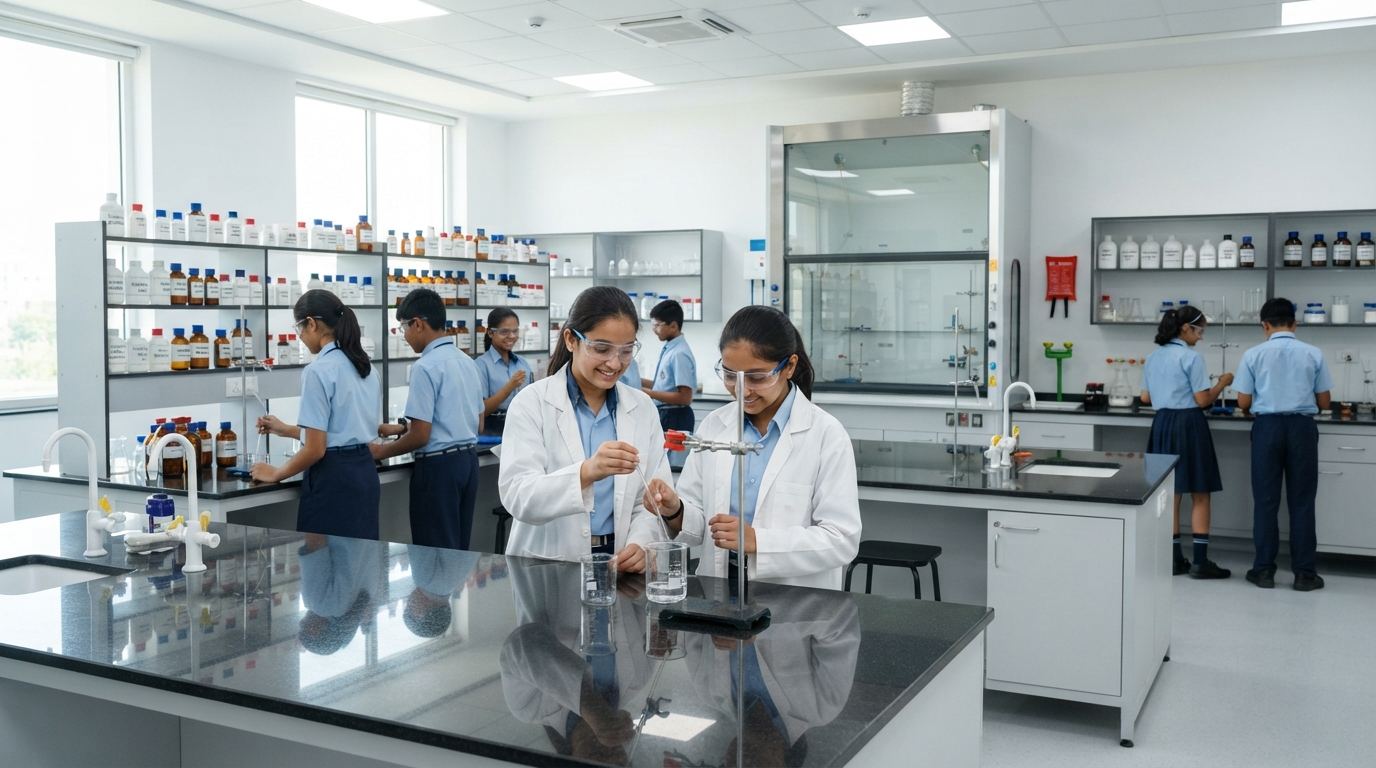
Our standard layout for a 9 m × 6 m room places student workbenches in rows or islands with a minimum 1.2 m aisle, the demonstration bench at the front near the blackboard or interactive panel, the fume hood on an external wall for the shortest duct run, and chemical storage on the wall farthest from the exit. Cross-ventilation is planned with window positions and exhaust fans so heavier-than-air fumes are pulled away at bench height — not left to drift across seated students. Gas, if you opt for burner lines instead of spirit lamps, comes from a cylinder bank outside the room with an emergency shut-off inside the door.
Under CBSE affiliation bye-laws, a senior secondary chemistry lab should be a separate room of roughly 9 m × 6 m (about 600 sq ft) with individual working space for each student during practicals. If your school teaches only up to Class 10, a chemistry zone inside a composite science lab is sufficient.
Workbenches, Sinks & the Fume Hood
Student Workbenches
Granite or epoxy-resin tops that shrug off acid spills, central or end sinks with acid-resistant PP waste lines, two-tier reagent racks down the spine, and under-bench cupboards. Standard 4-student and 6-student configurations, sized to your room.
Demonstration Bench
A raised teacher's bench with its own sink, gas point, and power — positioned so a full class can watch a reaction safely. Doubles as the examiner's station during board practicals.
Ducted Fume Hood
A fume hood is where concentrated acids, ammonia, and anything that produces vapour belongs. We supply and install ducted fume hoods with acid-resistant liners, sash front, internal light, and blower vented through the external wall or roof.
Chemical & Glassware Storage
Lockable chemical cupboards with segregated, labelled shelving, a separate flammables cabinet, and glass-front cabinets for glassware — so stock checks and board inspections take minutes, not days. Full details on our lab furniture page.
Chemistry Lab Equipment List (Glassware & Apparatus)
Quantities below are our standard recommendation for a 30-student batch working in pairs; every quotation is itemised so you can scale up or down. All glassware is laboratory-grade borosilicate.
| Item | Typical Spec | Suggested Qty (30 students) |
|---|---|---|
| Beakers | 100 ml, 250 ml, 500 ml borosilicate | 30 of each size |
| Burettes with stands | 50 ml, glass stopcock, boss-head clamp | 15 sets |
| Pipettes | 10 ml / 25 ml volumetric, with fillers | 15 of each |
| Conical flasks | 100 ml, 250 ml | 30 of each |
| Volumetric flasks | 100 ml, 250 ml | 15 of each |
| Measuring cylinders | 10 ml, 50 ml, 100 ml | 15 of each |
| Test tubes & racks | 15 × 125 mm, wooden/PP racks, holders, brushes | 300 tubes, 15 racks |
| Burners | Spirit lamps or LPG bunsen burners with tripod stands & wire gauze | 15 sets |
| China dishes, watch glasses, crucibles | Porcelain, with tongs | 15 of each |
| Funnels, glass rods, wash bottles | 75 mm funnels, 500 ml wash bottles | 15-30 each |
| Reagent bottles | 125 ml / 250 ml, glass, dropper and stoppered | 100+ assorted |
| Thermometers | 0-110°C, plus digital option | 15 |
| Balance | Electronic, 0.01 g readability (plus one 0.001 g for senior classes) | 2-3 |
| Water bath & kettle | Copper/SS water bath, electric | 2 |
| Distillation / distilled water supply | Distilled water plant or carboys with dispensers | 1 setup |
| pH meter & indicator papers | Digital pH meter, universal indicator, litmus | 2 meters + class stock |
| Chromatography & filtration consumables | Whatman filter paper, chromatography strips | Annual stock |
Reagents & Safe Chemical Storage
We stock the lab against your board's practical syllabus — for CBSE Classes 11-12 that means the acids, bases, and salts needed for volumetric analysis and qualitative salt analysis, plus organic reagents for functional-group tests:
- Mineral acids & bases — hydrochloric, sulphuric, and nitric acid; sodium hydroxide, ammonium hydroxide — supplied in laboratory grades with dilution SOPs for the lab assistant.
- Salts for qualitative analysis — the standard range of carbonates, chlorides, sulphates, nitrates, and metal salts needed for anion/cation identification practice.
- Volumetric reagents & indicators — oxalic acid, Mohr's salt, potassium permanganate, phenolphthalein, methyl orange, starch solution.
- Organic test reagents — Fehling's, Tollens', Schiff's reagent and the like for functional-group and food-adulteration tests.
Storage discipline is part of the installation, not an afterthought: acids stored low and never above shoulder height, oxidisers physically separated from flammables and organics, a lockable poisons shelf with register, dated labels on every bottle, and a spill kit (sand, sodium bicarbonate, absorbent) within reach. We hand over a stock register and storage map your lab assistant can maintain — and your inspector will appreciate.
Safety Gear for the Chemistry Lab
Every chemistry lab we install ships with a safety package as standard: class sets of splash-proof safety goggles, lab aprons, and nitrile gloves; a plumbed or gravity-fed eye-wash station beside the benches; CO2 and DCP fire extinguishers with a sand bucket and fire blanket; a stocked first-aid box with burn dressings; and safety signage at the door and above storage. For labs running LPG burner lines, we add a gas leak detector and an emergency shut-off valve inside the room.
Mapped to CBSE Class 11-12 Chemistry Practicals
The equipment list is only right if it covers every practical your students will be examined on. This is how the CBSE senior secondary chemistry practical syllabus maps to what we supply:
| Practical Area | What Students Do | Key Equipment We Supply |
|---|---|---|
| Volumetric analysis (titration) | Prepare standard solutions; titrate KMnO4 vs oxalic acid / Mohr's salt | Burettes, pipettes, volumetric flasks, balances, indicators |
| Qualitative salt analysis | Identify one cation and one anion in a given salt | Test tubes, reagent range, burners, centrifuge (optional), spot plates |
| Thermochemistry | Enthalpy of dissolution / neutralisation | Calorimeters (polythene/copper), thermometers 0.1°C |
| Electrochemistry & kinetics | EMF of cells; rate vs concentration studies | Cell assemblies, voltmeter, stop clocks, graduated glassware |
| Chromatography | Separate pigments/ions on paper | Chromatography paper, jars, capillaries, solvents |
| Preparation of compounds | Inorganic double salts, organic derivatives | Crystallising dishes, funnels, water baths, drying oven (optional) |
| Tests for functional groups & biomolecules | Detect alcohols, aldehydes, carboxylic acids; test foodstuffs | Organic reagent set, water baths, test-tube batteries |
| Colloids & surface chemistry | Prepare sols and emulsions | Beakers, glass rods, burners, dialysis material |
For ICSE/ISC and Karnataka PU (DPUE) schools, we substitute the equivalent practical lists from those boards — the room design stays the same, the consumable mix changes.
Indicative Chemistry Lab Budgets
| Setup Level | What It Covers | Indicative Budget* |
|---|---|---|
| Chemistry zone in a composite lab (Classes 6-10) | 2-3 benches with sinks, basic glassware and reagent set, safety package | ₹2 – 3.5 lakh (as part of composite lab) |
| Standard senior secondary chemistry lab | Full furniture, fume hood, complete CBSE 11-12 equipment and reagent stock, safety package, installation | ₹6 – 9 lakh |
| Advanced / multi-section lab | Deeper glassware sets, second fume hood or larger storage, distilled water plant, digital balances, spares | ₹9 – 12 lakh |
* Indicative ranges for a typical 30-40 student batch, excluding civil work. Request an itemised quotation for your room dimensions and board.
Frequently Asked Questions
What equipment is required for a school chemistry lab?
The core list: borosilicate glassware (beakers, burettes, pipettes, conical and volumetric flasks, measuring cylinders, test tubes), burners with tripods and wire gauze, electronic balances, water baths, thermometers, reagent bottles, and the reagent stock for your board's practicals — plus acid-resistant workbenches with sinks, a fume hood, segregated chemical storage, and safety equipment. Our equipment table above gives suggested quantities for a 30-student batch.
Does a school chemistry lab really need a fume hood?
For senior secondary work, yes. CBSE Class 11-12 practicals involve concentrated acids, ammonia, and salt-analysis steps that generate vapours; a ducted fume hood keeps those away from students and is now a standard item on inspection checklists. For labs teaching only up to Class 10, strong forced-exhaust ventilation can be acceptable — we advise based on your board and the practicals you run.
How much does a chemistry lab setup for a school cost?
Indicatively, a complete senior secondary chemistry lab — furniture, fume hood, glassware, reagents, safety package, and installation — runs Rs. 6-9 lakh, and Rs. 9-12 lakh for advanced or multi-section setups. A chemistry zone within a composite lab for Classes 6-10 costs roughly Rs. 2-3.5 lakh as part of that project. Civil work is extra. These are indicative ranges; the itemised quote depends on your room and batch size.
How are chemicals stored safely in a school lab?
In lockable, labelled cupboards with strict segregation: acids away from bases, oxidisers (like potassium permanganate) physically separated from flammables and organic solvents, concentrated acids stored below shoulder height, and a poisons shelf under lock and register. Flammables get their own cabinet. We set up the storage map, dated labelling, and stock register as part of installation, and train your lab assistant to maintain them.
Do you restock chemicals and replace broken glassware during the year?
Yes. Most schools take our annual replenishment plan: we audit stock once or twice a year, top up reagents and consumables (filter paper, litmus, indicators), and replace glassware breakage at contracted rates. Schools on AMC also get a pre-inspection check before CBSE or state board visits.
Can you upgrade our existing chemistry lab instead of building new?
Absolutely — retrofits are common. Typical upgrades: replacing wooden tops with granite or epoxy, adding a fume hood and eye-wash station, renewing the reagent stock with proper storage, and bringing a Class 10-era lab up to senior secondary standard when the school adds Classes 11-12. We audit what you have and quote only for the gap.
Get an Itemised Chemistry Lab Quotation
Share your room size, board, and classes — we will send a layout, equipment list, and quotation within 2-3 working days. Free site visits across Bangalore.